
QUICK ANSWER
The product management process runs on two clocks. Advanced planning looks two to three years out (Y+2 to Y+3) and figures out what to build next. Current planning looks at this year and next (Y to Y+1) and makes the product that’s already on the market better and more profitable. Customer research and customer experience (CX) support both, and the product roadmap ties them together. AI helps a product manager on both clocks, just in different ways: when you’re looking ahead, it widens your view, and when you’re improving what you sell today, it sorts and measures. Either way, the decisions are still yours.
Most “product management process” guides draw one straight line from idea to launch. Real product work doesn’t look like that. Two different kinds of planning run at the same time, and they need different methods. This page maps out both. It’s also the table of contents for the whole series, so you can come back here whenever you need to find your place.
On this page
- Two clocks: advanced vs. current planning
- Why AI needs a different approach in each
- The full map: five areas of work
- 1. Advanced planning (Y+2 to Y+3)
- 2. Current planning (Y to Y+1)
- 3–5. Research, CX, and roadmap: same names, different jobs
- If you’re a team of one
- Four checks before you trust an AI answer
- Where this map doesn’t fit
- FAQ
Two clocks: advanced vs. current planning
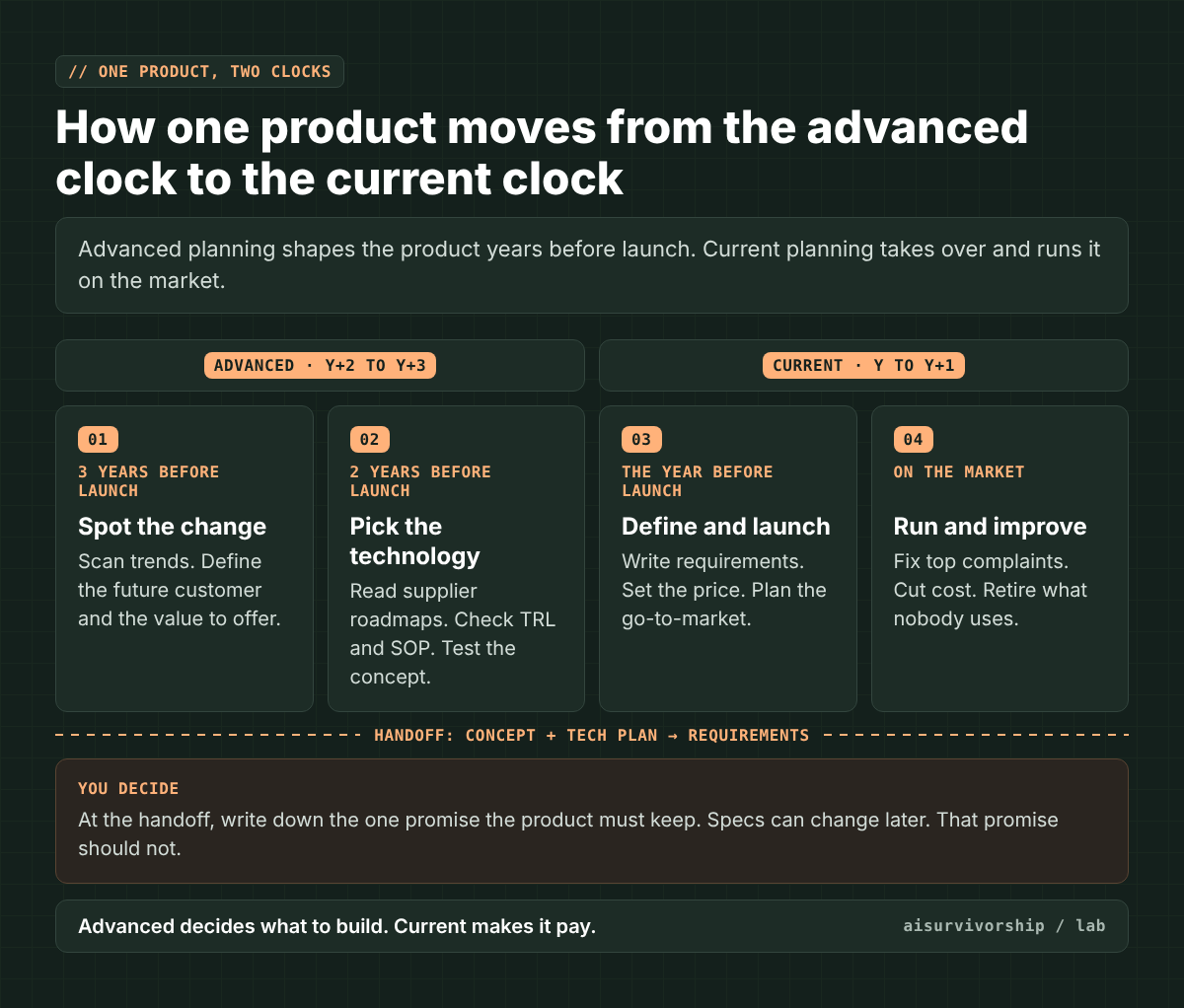
Advanced planning (sometimes called future or pre-development planning) is about a product nobody can see yet. You read trends, match customer needs to technology that suppliers will have ready in time, and lay out the basic structure of the next platform. Think of it as strategy and exploration.
Current planning (also called lifecycle or mass-production planning) is about the products that are already on the market or about to launch. You manage profit and loss, fix what customers complain about, cut costs, and support the launch. Think of it as execution and fine-tuning.
| Advanced planning | Current planning | |
|---|---|---|
| Time horizon | Y+2 to Y+3 and beyond | Y to Y+1 |
| Core question | What should we build next? | How do we make this product better and more profitable? |
| Main inputs | Trends, weak signals, supplier technology roadmaps, hypotheses | Reviews, support tickets, NPS, usage data, P&L |
| Main outputs | Concepts, technology sourcing plans, a three-year roadmap | Requirements, fix priorities, cost-down plans, launch plans |
| What success looks like | A hypothesis was tested, and kept or killed | A metric moved: conversion, NPS, cost, or revenue |
Why AI needs a different approach in each
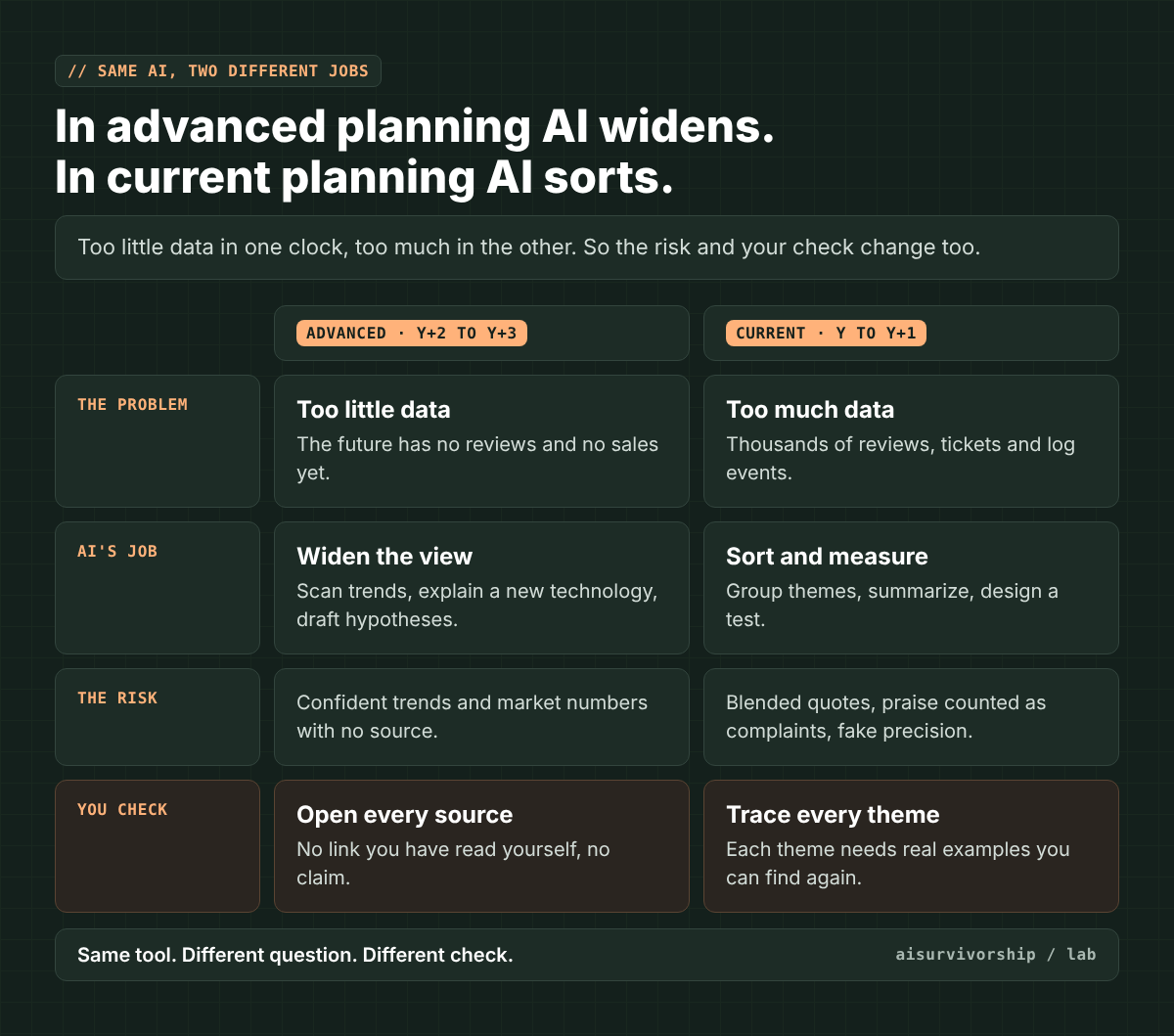
This is the part most AI guides skip. A prompt that works great on one clock can lead you astray on the other.
In advanced planning, the problem is too little data. You’re asking about a future that has no reviews and no sales yet. So AI is useful for widening the search: listing trends you missed, explaining an unfamiliar technology, drafting hypotheses. The catch? It’ll happily fill the gaps with confident-sounding trends and market numbers that have no source at all. So every claim needs a link you’ve actually opened.
In current planning, it’s the opposite: too much data. You’ve got thousands of reviews, tickets, and log events. Here AI earns its keep by sorting, summarizing, and helping you figure out how to measure a change. The risk looks different, though. It mixes up quotes, counts praise as complaints, and hands you precise-looking percentages from a sample it never really counted. So every theme needs examples you can trace back.
The full map: five areas of work
Here’s the whole job in five areas. Two of them belong to one clock each. The other three show up on both clocks, but you do them differently on each.
| Area | Clock | What it covers |
|---|---|---|
| 1. Advanced planning | Y+2 to Y+3 | Market and trend analysis, future customers and value proposition, technology sourcing, early feasibility and concept tests |
| 2. Current planning | Y to Y+1 | Voice of the customer and quality data, feature fixes and UX updates, cost-down and lineup cleanup, launch and sales support |
| 3. Customer research | Both | Surveys and usage data, interviews and usability tests, personas and journey maps |
| 4. Customer experience (CX) | Both | Touchpoints from awareness to repurchase, CX metrics (NPS, CSAT, CES), work across teams |
| 5. Roadmap | Both | Next year’s action plan, the three-year roadmap, portfolio balance, leadership alignment |
1. Advanced planning (Y+2 to Y+3)
The goal here is to spot needs nobody’s meeting yet, match them with technology that’ll be ready in time, and sketch the basic structure of the next product platform.
Market and environment scan (PEST, 3C)
Keep an eye on long-term industry trends, how fast new technologies are catching on, and changes in regulation. Then make your best guess about what competition will look like in three years, and where the gaps are. AI can draft: a first PEST scan, a 3C summary, a list of signals to watch. You decide: which trends are real for your customers, after you’ve checked the sources.
Future customers and value proposition
Picture how your target customer’s life and habits will have changed by the time the product ships. Then write down what you’ll offer them. AI can draft: future personas and a value proposition canvas. You decide: which change you’re betting on.
Technology sourcing from supplier roadmaps
Gather and read the technology roadmaps of your key component and software suppliers. For each technology, check how mature it is (technology readiness level, or TRL) and when it can be mass-produced (start of production, or SOP). Line those dates up with your own roadmap. Then decide how you’ll work with the partner: a proof of concept (PoC), joint development, or something else. AI can draft: plain-language explanations of a technology and a comparison table. You decide: the timing and the partnership. Keep in mind that AI has no idea what your suppliers’ real dates are.
Early feasibility and concept testing
Check with R&D whether it can actually be built, estimate a rough cost of goods sold (COGS), and test the concept with real people before anyone commits. AI can draft: a cost structure template and a concept test survey. You decide: keep going, change course, or stop.
Guides for this track: Start with the track hub, Advanced product planning: how to plan products two to three years ahead. Step-by-step guides follow over the next two weeks.
2. Current planning (Y to Y+1)
The goal here is to keep the products you already sell profitable, and to make them stronger using real feedback and data.
Voice of the customer and quality data
Go through support tickets, reviews, NPS and CSAT results, and usage logs. Pull out the biggest pain points and quality issues, then decide what to fix first. AI can draft: theme groupings and summaries. You decide: the ranking, once you’ve checked that each theme has real examples behind it.
Feature fixes and UX updates
Write a product requirements document (PRD) for short-term fixes, and work them through with R&D and design. Plan A/B tests, and keep an eye on key metrics after release, like conversion or time spent. AI can draft: a PRD outline and a test plan. You decide: the scope and the success metric.
Cost-down and lineup cleanup (VAVE, EOL)
Look for alternative parts and leaner specs that cut cost without hurting the product (value analysis and value engineering, or VAVE). And retire features and models that barely earn anything or that hardly anyone uses (end of life, or EOL). AI can draft: a list of options and a checklist. You decide: what customers would actually miss.
Launch and sales support (GTM)
Work out pricing and channel strategy with sales, marketing, and customer service. Give the sales team the material they need, and watch how the market reacts early on. AI can draft: a go-to-market (GTM) plan outline and a one-page sales sheet. You decide: price and positioning.
Guides for this track: Start with the track hub, Current product planning: how to manage a product already on the market. Then How to write a customer survey with AI (without leading questions). More guides are coming soon.
3–5. Research, CX, and roadmap: same names, different jobs
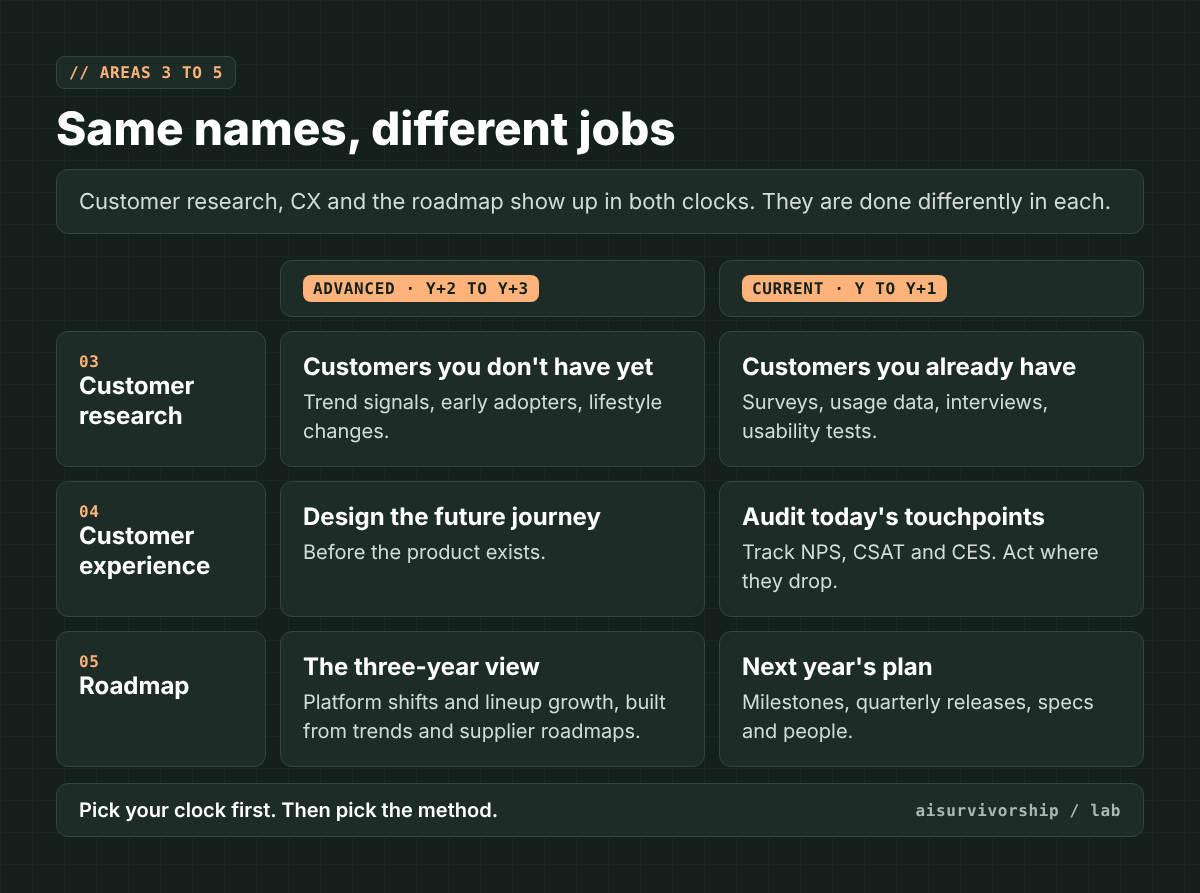
These three areas show up on both clocks, and that’s exactly why they’re easy to get wrong. Researching customers for a product that doesn’t exist yet is a completely different job from researching a product you already sell. So this series covers each of them twice, once per track.
| Area | In advanced planning | In current planning |
|---|---|---|
| 3. Customer research | Customers you don’t have yet: trend signals, early adopters, lifestyle changes | Customers you already have: surveys, usage data, interviews, usability tests |
| 4. Customer experience (CX) | Design the future journey before the product exists | Audit today’s touchpoints and manage NPS, CSAT, and CES |
| 5. Roadmap | Y+2 to Y+3: platform shifts and lineup expansion, built from advanced planning and supplier roadmaps | Y+1: milestones, quarterly releases, specs, and resources |
The roadmap is where the two clocks meet. Balancing the portfolio means splitting money and people between today’s earners (cash cows) and tomorrow’s bets (stars and question marks, in the BCG matrix). Then comes the hard part: getting leadership and the other teams to agree on it.
If you’re a team of one
At a big company, there’s a separate person for each box on this map. If you’re a small seller or running a side project, that person is you. Good news: the two clocks still apply. They just get smaller.
- Current clock, every week: read your newest reviews and messages, list the top three complaints, and fix one.
- Advanced clock, once a month: spend an hour thinking about what your customers might need next year, and write down one hypothesis to test.
- Roadmap, once a quarter: one page with two columns, “keep improving” and “next bet.”
Four checks before you trust an AI answer
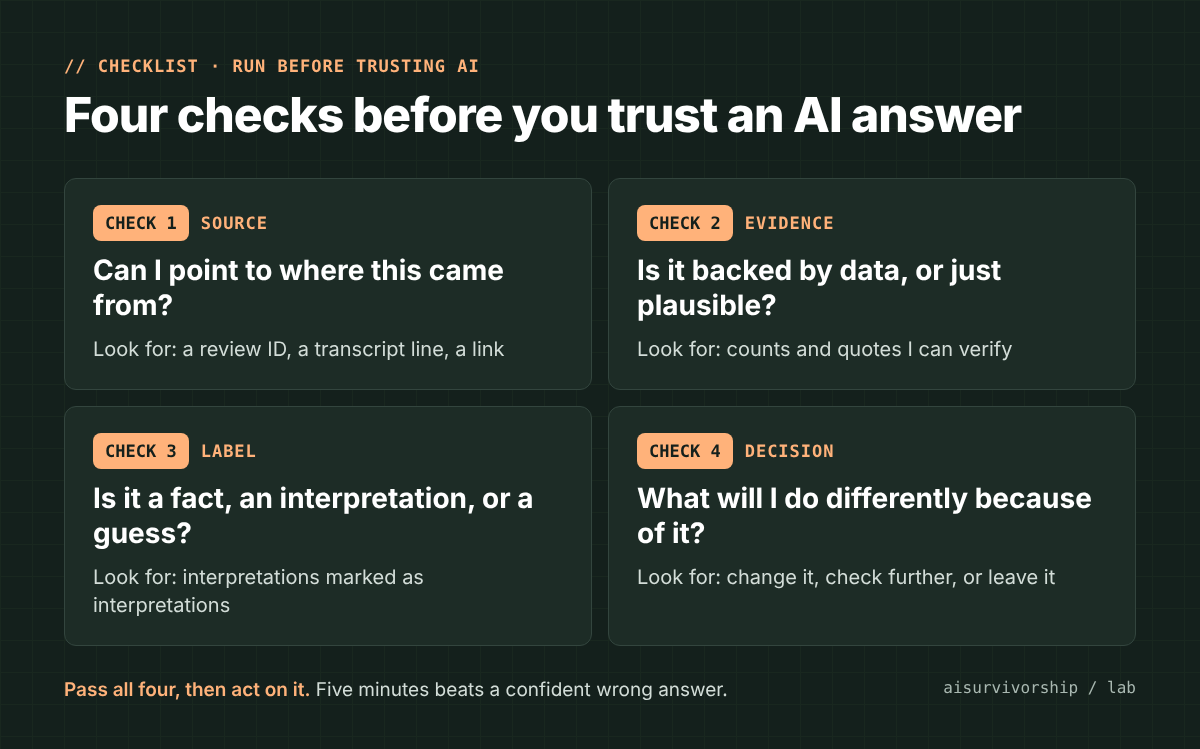
Whichever clock you’re on, run these four checks before you act on anything AI tells you:
- Source: Can you point to where it came from, like a review ID, a line in a transcript, or a link?
- Evidence: Is it backed by data you can check, or does it just sound right?
- Label: Is it a fact, an interpretation, or a guess?
- Decision: What will you do differently because of it? If the answer is nothing, it doesn’t belong in the plan.
Where this map doesn’t fit
This map comes from hardware product planning, where products take years to develop. Software teams that ship every week often blur the two clocks, because their “future” might just be next quarter. Job titles vary, too. A lot of companies call this role product management, and some split it across strategy, product marketing, and product management. The work is pretty similar, even when the boxes are drawn differently.
Real work also loops back on itself. A concept test sends you back to research. A cost-down plan changes next year’s roadmap. So use the map to see which job you’re doing right now, not as a strict sequence.
FAQ
What does a product manager do in product planning?
A product manager (some companies say product planner) decides what the company should build next and keeps the products it already sells competitive. In practice, that splits into advanced planning (two to three years out) and current planning (this year and next), with customer research, CX, and the product roadmap supporting both.
What’s the difference between advanced and current product planning?
Advanced planning shapes future products from trends and technology, and it’s judged by whether its hypotheses hold up. Current planning manages products already on the market, and it’s judged by whether metrics like NPS, cost, and revenue get better.
Can AI do product management for me?
It can draft most of the documents, scans, and summaries. What it can’t do is make the decisions, because those depend on your customers, your suppliers, and how much risk you can take.
Where should a beginner start?
Start with the clock you’re on today. If you own a product that’s already on the market, begin with the current planning track. If your job is to find the next product, begin with the advanced planning track.
This page gets updated every time a new guide in the series goes live.