
QUICK ANSWER
A supplier technology roadmap shows when a supplier expects a new part, material, or technology to be ready. Read it as a set of promises with different strengths, not as a schedule. For every item, ask five things: how firm is it, which date is it (sample or mass production), what spec comes with that date, who else gets it, and what has to go right for the date to hold. Then line the dates up against your own product roadmap and leave a buffer. AI is useful for turning your notes into a comparison table and a question list. Never paste a supplier’s confidential material into a public AI tool.
Where this sits on the map: Advanced planning track (Y+2 to Y+3) · Technology sourcing. See the advanced planning hub for the full track.
On this page
- TRM and PRM in plain words
- Why advanced planners read supplier roadmaps
- Five questions for every roadmap item
- Line it up with your own roadmap
- Where AI helps, and where it is risky
- Copy-and-paste prompts
- Example (fictional)
- Limits
- FAQ
TRM and PRM in plain words
Two terms come up in every supplier meeting:
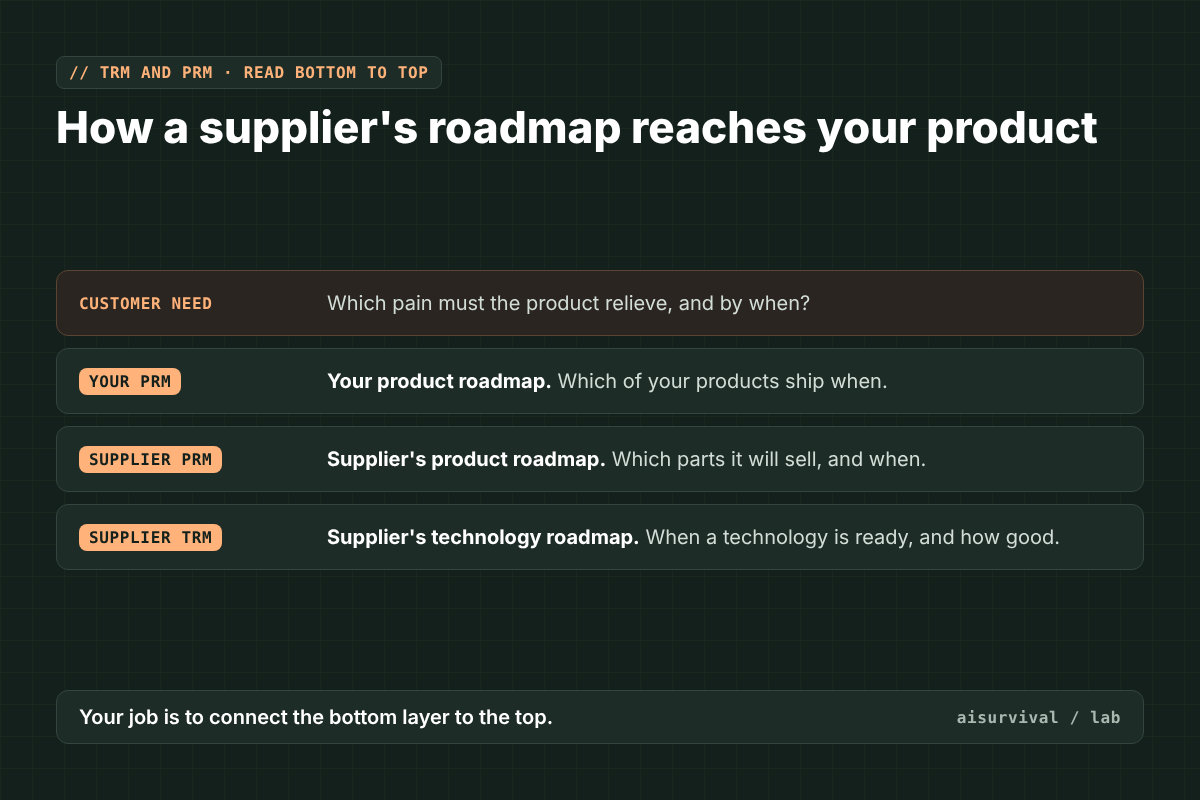
- Technology roadmap (TRM): when a technology, part, or material is expected to be ready, and how good it will be. Think “a battery cell with 20% more capacity, samples in 2027.”
- Product roadmap (PRM): which products will ship when, and with which features. Your company has one. So does your supplier, for the parts it sells.
Some companies use slightly different names or abbreviations, so check what your team means before a meeting. The idea is the same everywhere: the supplier’s technology roadmap feeds its product roadmap, and its product roadmap feeds yours.
Roadmapping as a business practice is widely traced to Motorola, which started using roadmap methods in the late 1970s (Umbrex summary). The University of Cambridge’s Institute for Manufacturing teaches a version that links three layers: market, product, and technology (IfM Engage). That layering is handy here. A supplier roadmap mostly lives in the bottom layer. Your job is to connect it upward to products and customers.
Why advanced planners read supplier roadmaps
If you’re planning a product two or three years out, some of its key parts don’t exist yet. They exist on a supplier’s slide. So the question “can we build this?” often turns into “will the part be ready, at the spec we need, at a price we can live with, in time?”
That’s also why this guide comes right after the value proposition canvas. The canvas tells you which customer pain you want to relieve. The supplier roadmap tells you whether the technology to relieve it will arrive in time.
Five questions for every roadmap item
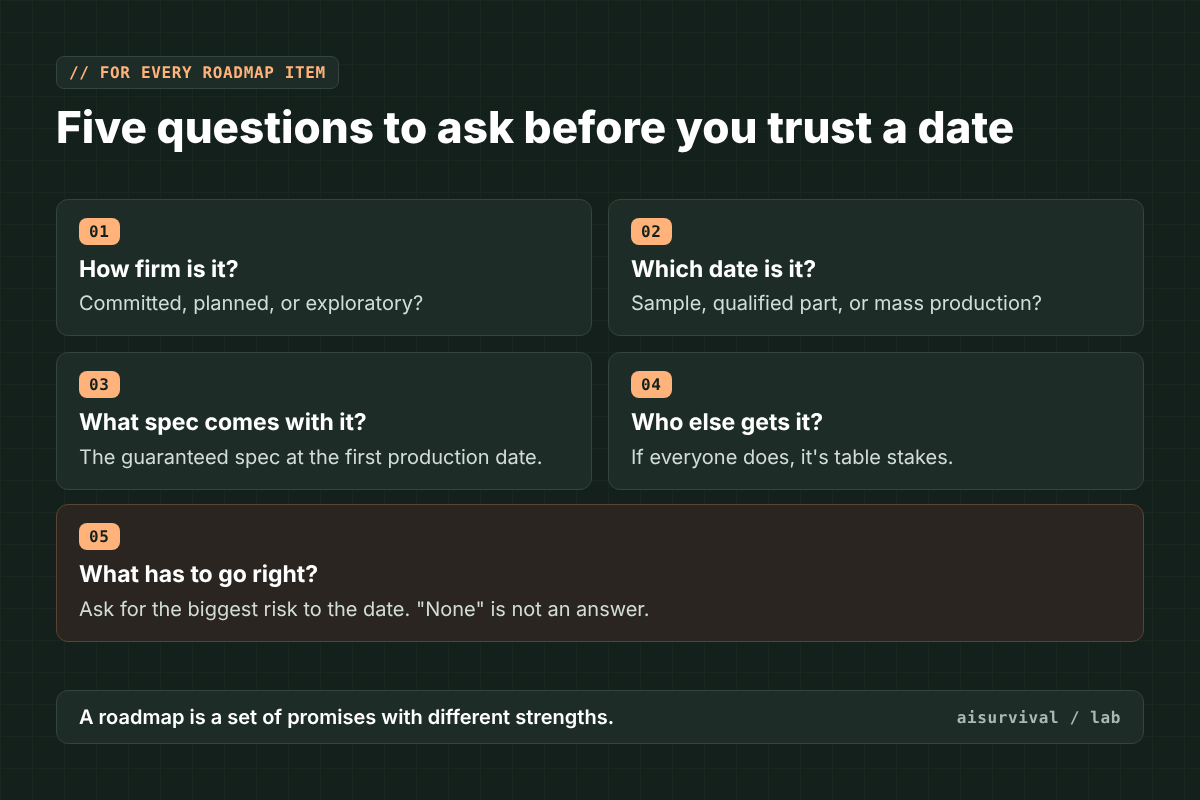
Supplier roadmaps are sales documents as much as plans. That’s not a criticism. It just means every line deserves the same five questions.
1. How firm is it?
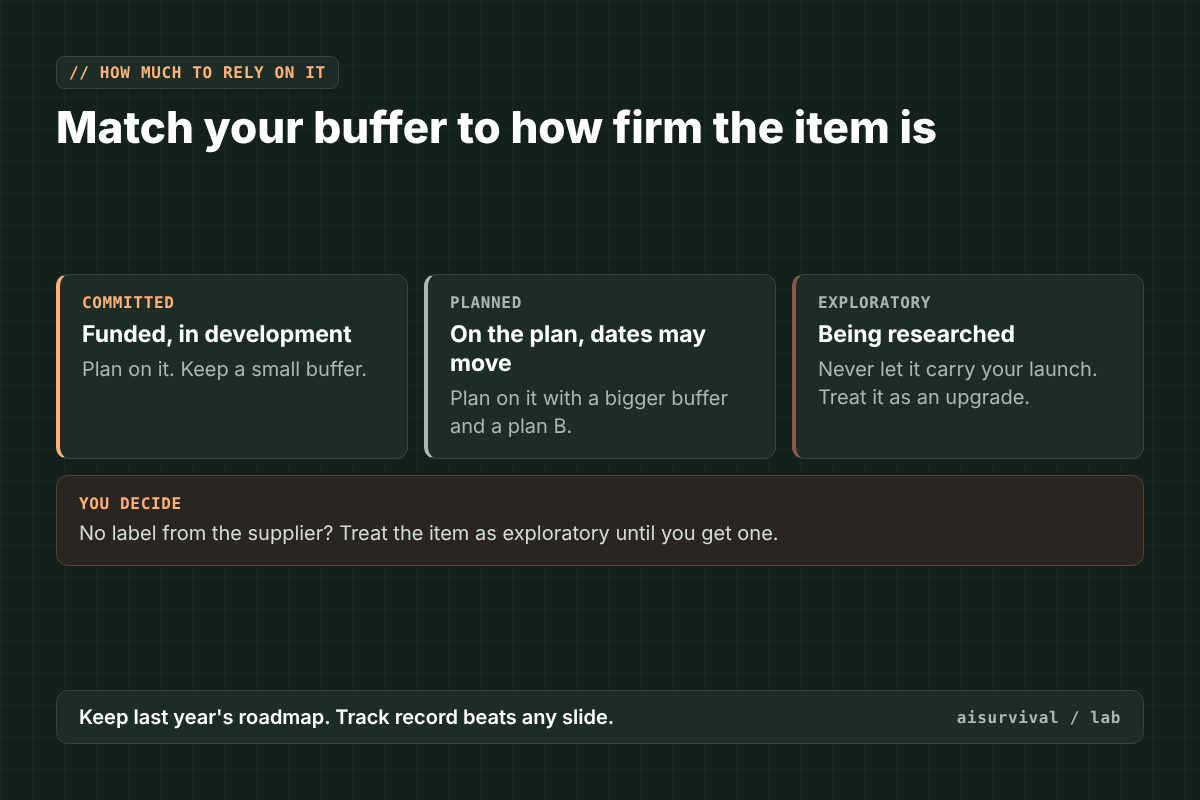
Ask the supplier to label each item. A simple three-level scale works: committed (funded, in development, dates the supplier will stand behind), planned (on the plan, but dates may move), and exploratory (being researched, no promise). If they won’t label it, treat it as exploratory.
2. Which date is it?
“2027” can mean first engineering samples, a qualified part, or the start of mass production (often called SOP, start of production). Those can be a year or more apart. Always ask which milestone a date refers to.
3. What spec comes with that date?
A slide might show the best spec and the earliest date side by side. They may not arrive together. Ask: “At the first production date, what exact spec is guaranteed?”
4. Who else gets it?
If every competitor gets the same part at the same time, it’s not a differentiator. It’s table stakes. Ask whether there’s any early access or a joint development option, and what it would cost.
5. What has to go right?
Every date rests on something: a new factory line, a material qualification, a standard being finalized. Ask the supplier to name the biggest risk to the date. A supplier that can name one is usually more credible than one that says there’s none.
One more habit: keep last year’s roadmap. Comparing what a supplier promised with what actually shipped is the best evidence you’ll get about how to read its next one.
Line it up with your own roadmap
Reading the roadmap is half the job. The other half is putting the supplier’s dates next to your own plan:
- Write down your target launch date and work backward to the date you need final parts (for design freeze, testing, and certification).
- Place each supplier milestone on the same timeline: sample, qualified part, mass production.
- Mark the gap. If the supplier’s mass production date lands after the date you need parts, you have a problem today, not in two years.
- Add a buffer that matches the firmness level. Committed items need less buffer than planned ones. Exploratory items shouldn’t carry your launch at all.
- Write a plan B for anything planned or exploratory: an older part, a second supplier, or a smaller first version.
Large company: a planning team collects roadmaps from several suppliers under NDA, compares them in a sourcing review with R&D and procurement, and updates the product roadmap every cycle.
Small seller: your “supplier” might be a factory, a materials vendor, or a software platform you build on. Ask the same five questions in an email, keep the answers in one sheet, and re-ask every six months.
Where AI helps, and where it is risky
AI is good at the boring middle. Give it your own meeting notes, with names and confidential details removed, and it can turn messy bullet points into a clean table: item, milestone, date, spec, firmness, open question. It’s also good at spotting what you forgot to ask.
There are two big risks. The first is confidentiality. Supplier roadmaps are usually shared under a non-disclosure agreement (NDA). Pasting one into a public AI tool can break that agreement and your company’s rules. Use only a company-approved tool, or work from public sources and your own redacted notes.
The second is invention. Ask a chatbot “when will this technology be ready?” and it may give you a confident year with nothing behind it. Never let AI fill in a date the supplier didn’t give you.
Copy-and-paste prompts
How to use these:
- Remove supplier names, prices, and anything marked confidential from your notes first.
- Run Prompt 1 on your notes to build the table.
- Check every row against the original notes yourself.
- Run Prompt 2 to prepare your next supplier meeting.
- Run Prompt 3 after you add your own launch dates.
Tip: if your company has an approved internal AI tool, use that one for anything work-related.
Prompt 1: Turn meeting notes into a roadmap table
Below are my notes from a supplier roadmap meeting. Names and confidential details are removed.

[paste notes]

Turn them into a table with these columns:
Item | Milestone (sample / qualified part / mass production) | Date | Spec at that date | Firmness (committed / planned / exploratory / unknown) | Open question

Rules:
- Use only what is in my notes. If a value is missing, write UNKNOWN.
- Do not guess dates or specs.
- After the table, list every item where the firmness is unknown.
Prompt 2: Prepare questions for the next meeting
Here is my roadmap table: [paste table]

For each row with UNKNOWN or "planned/exploratory" firmness, write up to 2 questions I should ask the supplier.
Cover: which milestone the date refers to, the guaranteed spec at that date, exclusivity or early access, and the biggest risk to the date.
Keep each question short and neutral. No leading questions.
Prompt 3: Gap check against my launch plan
My target launch: [month, year]
I need final parts by: [month, year]
Supplier roadmap table: [paste table]

1. For each item, say ON TIME, TIGHT (less than 3 months of margin), or LATE.
2. For TIGHT and LATE items, suggest one plan B (older part, second source, smaller first version).
3. Do not change any date in the table.
Example (fictional)
Everything here is made up for illustration.
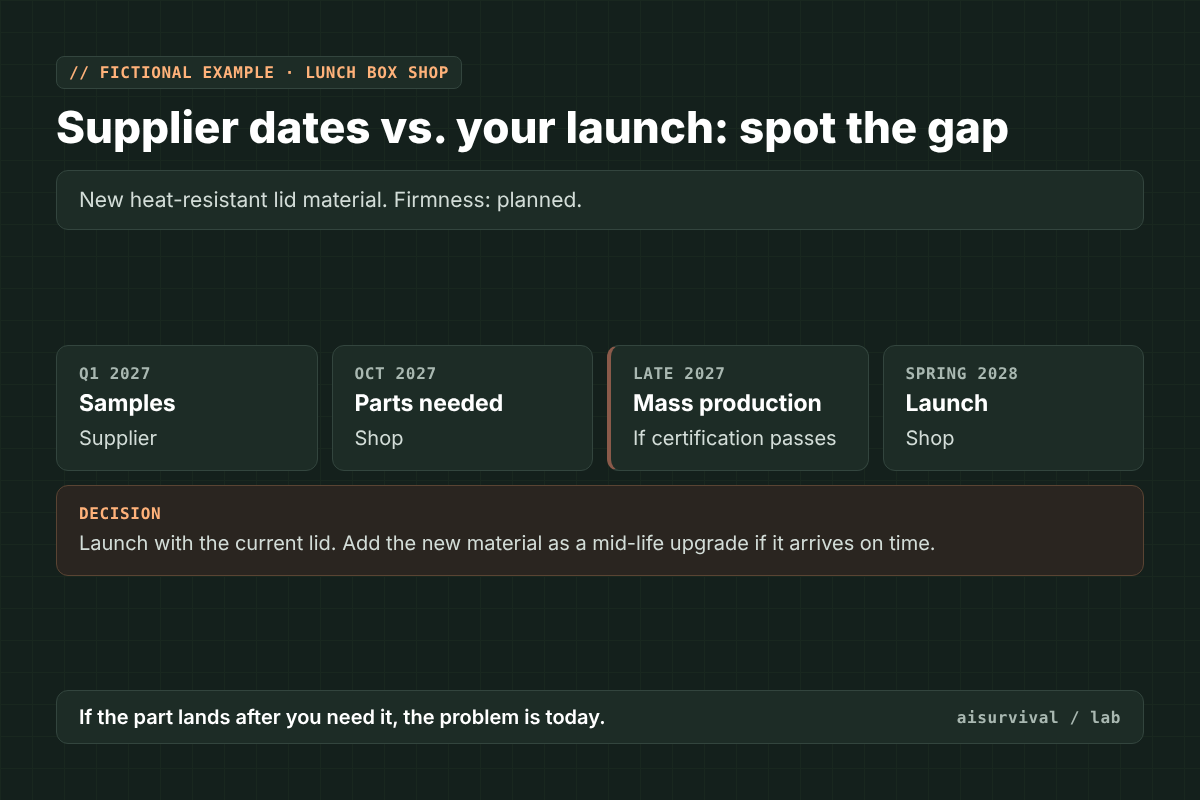
The two-person lunch box shop from the 3C guide wants a lid that doesn’t crack in the dishwasher. Their molding supplier shows a slide: “New heat-resistant lid material, 2027.”
After the five questions, the picture changes:
| Question | Answer (fictional) |
|---|---|
| How firm? | Planned. Funded for samples, not yet for mass production. |
| Which date? | Samples in Q1 2027. Mass production “late 2027, if qualification passes.” |
| What spec? | Heat rating at launch is lower than the slide’s headline number. |
| Who else? | Offered to all customers. No early access. |
| What has to go right? | A food-contact certification for the new material. |
The shop wants to launch in spring 2028 and needs final parts by October 2027. That leaves almost no margin, and the date depends on a certification. Decision: plan the 2028 launch with the current lid, and treat the new material as a mid-life upgrade if it arrives on time.
Quick checklist:
☐ Every item has a firmness label.
☐ Every date says which milestone it means.
☐ You know the guaranteed spec at the first production date.
☐ You know who else gets it.
☐ The biggest risk to each date is written down.
☐ Supplier dates sit on the same timeline as your launch, with a buffer.
☐ Nothing confidential went into a public AI tool.
Limits
- Roadmaps change. Re-check every cycle and keep old versions to compare.
- This guide isn’t legal advice. Follow your NDA and your company’s rules on sharing supplier information.
- AI can organize what you give it. It can’t tell you when a technology will really be ready.
- Firmness labels are only as honest as the supplier. Track record matters more than any single slide.
FAQ
What is the difference between a technology roadmap and a product roadmap?
A technology roadmap shows when a technology or part will be ready and how good it will be. A product roadmap shows which products will ship when, and with which features. The first usually feeds the second.
What does SOP mean on a roadmap?
Start of production, the date mass production begins. It’s usually later than the first sample date. The next guide in this track covers it in detail.
Can I use ChatGPT to analyze a supplier roadmap?
Not with the supplier’s confidential files. Use a company-approved tool, or give a public AI only your own notes with names and confidential details removed.
How often should I review supplier roadmaps?
At least once per planning cycle, and whenever a date you depend on moves. Keep every version so you can compare promises with what shipped.
Where this fits: Advanced planning track · Technology sourcing, part of the product planning process series. Previous guide in this track: value proposition canvas with AI.
Next in this track: TRL and SOP, or how to tell whether a technology is ready for your launch. Subscribe if you’d like it in your inbox.
Your turn: What’s the hardest question to get a straight answer to from a supplier? Tell us in the comments. Your answers shape future guides.