
QUICK ANSWER
Advanced product planning decides what you’ll build two to three years from now (Y+2 to Y+3). You won’t have sales data for any of it. You’ll have signals: trends, a handful of early customers, technology your suppliers are still working on. The job is to turn those signals into small, cheap bets and kill most of them before they cost real money. AI speeds up the searching. It also makes up sources, so check every one.
Where this sits on the map: Advanced planning track (Y+2 to Y+3) · Track hub. This page is the table of contents for every advanced planning guide in the product planning process series.
On this page
- What advanced planning is (and is not)
- The six steps
- Copy-and-paste prompt
- Worked example (fictional)
- Checklist
- Guides in this track
- Limits
- FAQ
What advanced planning is (and is not)
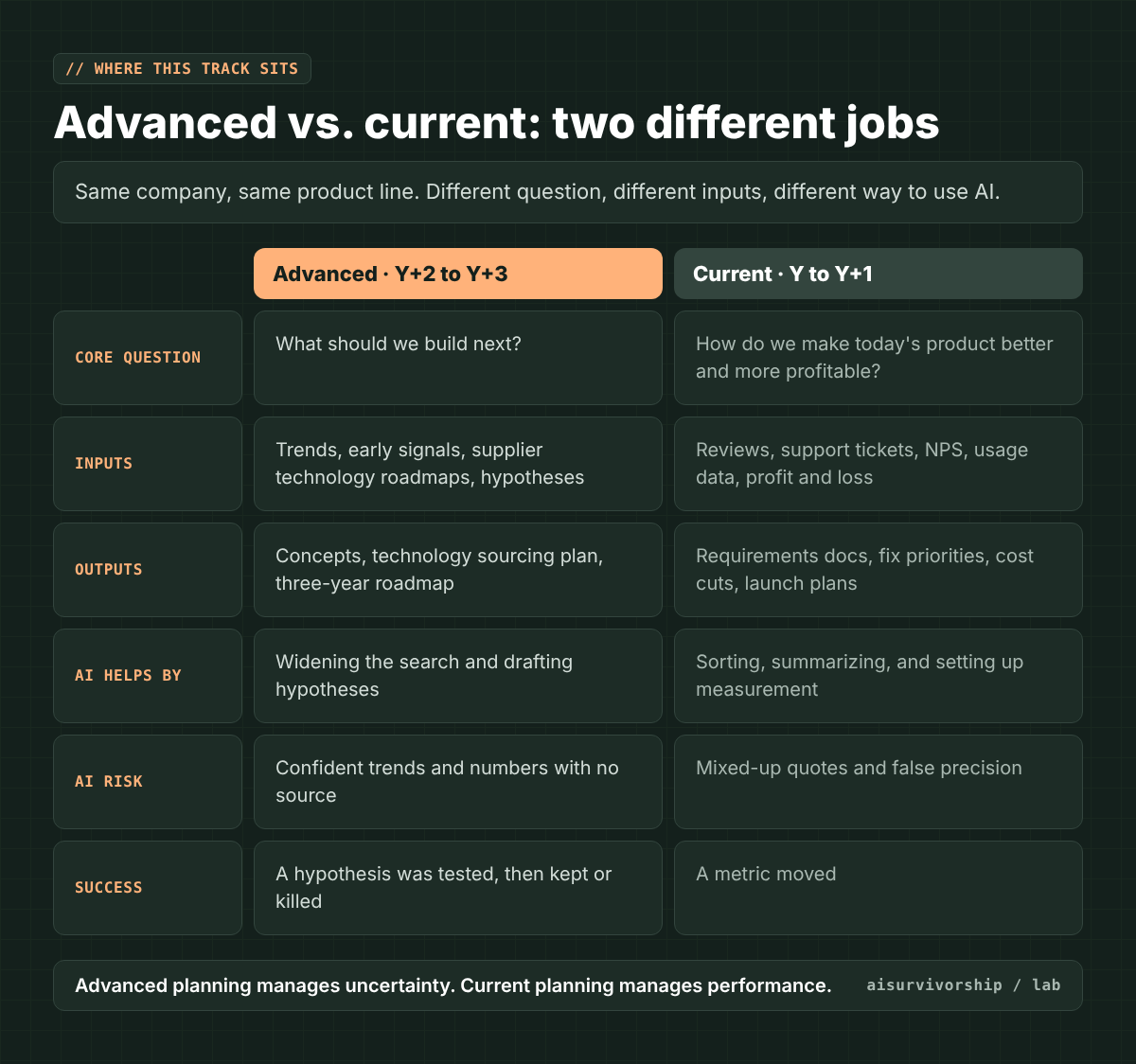
Product planning runs on two clocks. Current planning (Y to Y+1) looks after what’s already on the shelf: fixes, cost, launches. Advanced planning (Y+2 to Y+3) decides what goes on the shelf after that.
They don’t share a method. When a product is already selling, you have reviews and sales numbers to argue over. Three years out, you have none of that.
So stop trying to forecast. Nobody gets a market three years away right on paper. What you can do is test your guesses while they’re cheap, and drop the bad ones before a team gets attached to them.
AI helps a lot here, with one warning that’s worth repeating. Ask it about the future and it will answer with total confidence, often with trend names and market numbers that don’t trace back to anything. Each step below has a way to catch that.
The six steps
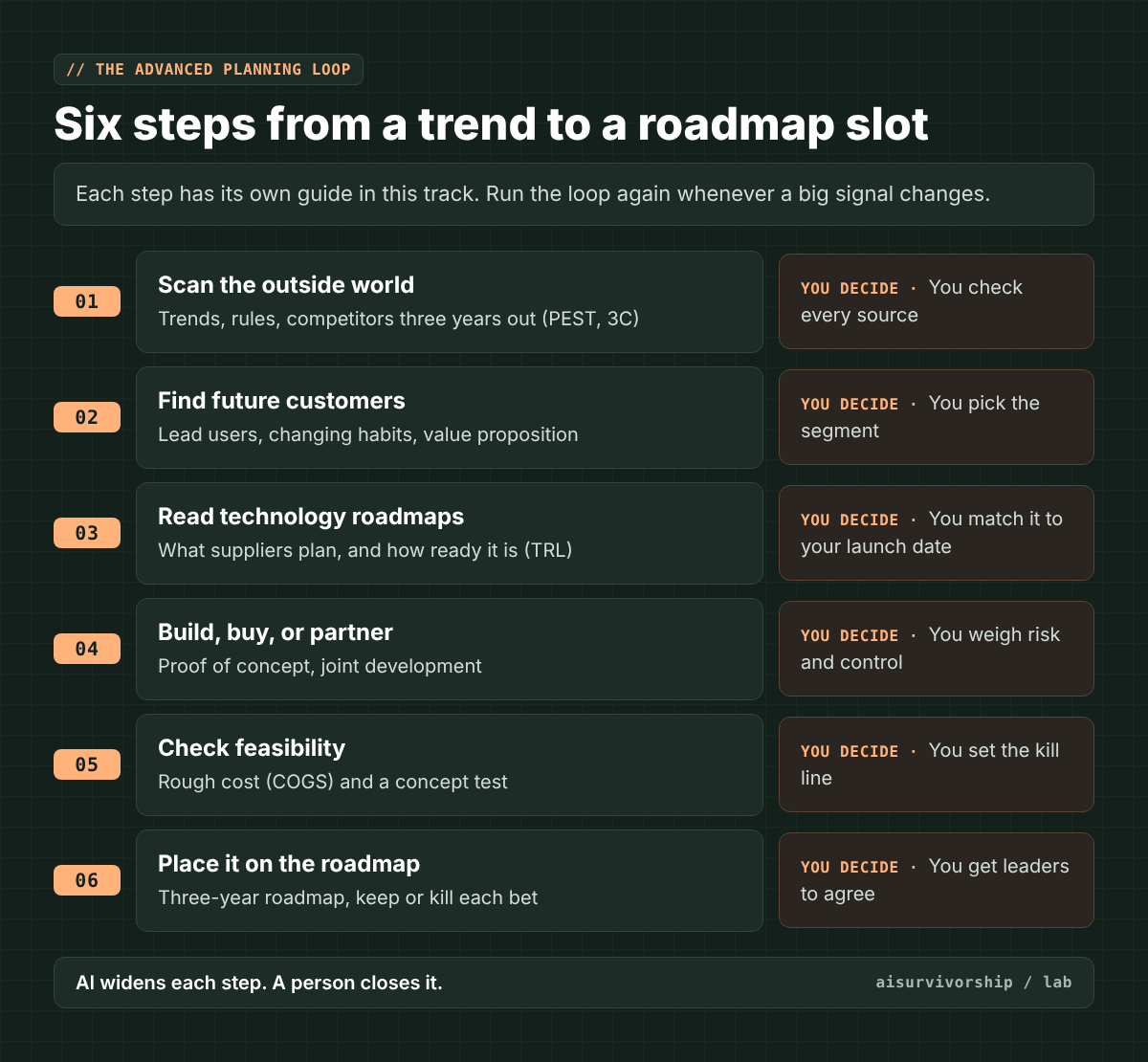
Step 1: Scan the outside world
PEST is the old standby for this: politics and regulation, the economy, society, technology. Go through each one and ask what could look different in three years. Then put customers, competitors, and your own company next to each other. That’s the 3C view.
Let AI write the first list. It’s fast, and it’ll name things you hadn’t considered. Then open every source it cites. Some will be missing, some will be years old, and a few will turn out to be about something else entirely.
The full walkthrough, with a prompt that forces a source on every line, is in PEST analysis with AI: scanning trends three years out.
Large company: a planning team may run this as part of a yearly strategy review.
Small seller: one afternoon per quarter is enough. Pick three shifts that could change what your customers buy, and ignore the rest for now.
Step 2: Find future customers
Current customers are good at describing today’s problems and not much help with tomorrow’s. MIT economist Eric von Hippel gave a name to the people worth finding instead: lead users. They run into a need months or years before the rest of the market, and it bugs them enough that they build their own fix (overview).
Those homemade fixes are your signal. A clunky spreadsheet someone built to track what your product doesn’t can tell you more than a page of five-star reviews.
Found a few? Write the value proposition in one sentence: what you’ll do for them that their workaround can’t. The full method is in how to research customers you don’t have yet, with lead users and AI.
Large company: formal lead user studies, future personas, and value proposition workshops.
Small seller: look for the five most extreme customers in your niche, in public forums or your own order history, and ask how they’re handling the problem today.
Step 3: Read technology roadmaps, and check readiness
Plenty of future products depend on technology another company is still building. A technology roadmap puts market needs, products, and the technology behind them on one timeline, so you can see what depends on what (Umbrex).
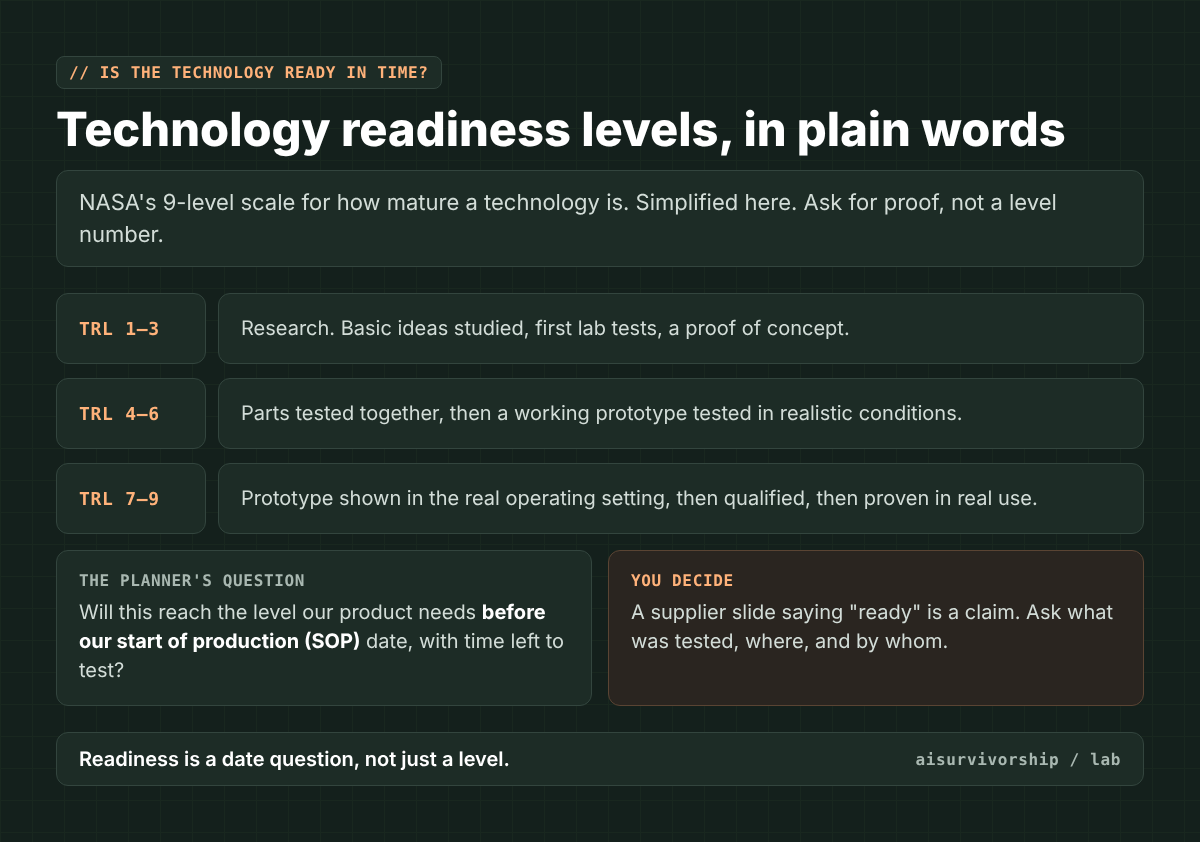
Then there’s readiness. NASA’s technology readiness levels (TRL) are the usual scale, running from early research at TRL 1 to proven in real use at TRL 9 (NASA). The level matters less than the date, though. Will the technology get where you need it before your start of production (SOP), the point where a product moves from development into regular manufacturing (Tacto)? If the honest answer is “probably, if nothing slips,” plan as if it’s a no.
Large company: planners may collect supplier roadmaps (when suppliers share them), match them against their own roadmap, and track readiness for each key part.
Small seller: read the public product updates from the two or three suppliers or platforms you rely on. When you talk to them, ask what’s being tested right now. Slides are cheap.
Step 4: Build, buy, or partner
You can build the technology yourself, buy it ready-made, or work with a partner. Partnerships usually start with a proof of concept (PoC), a small test to show the idea works at all. If that goes well, the next step might be a joint development agreement (JDA), where two companies develop something together under a contract.
AI is decent at listing pros and cons for each route. It has no feel for how much risk your company can stomach, and it shouldn’t be the one reading your contract.
Large company: a formal build-buy-partner review with engineering, purchasing, and legal.
Small seller: you’ll almost always buy or partner. Order a small paid sample or a pilot batch before you commit to anything bigger.
Step 5: Check feasibility cheaply
Two checks before real money goes in. Cost first: get a rough range for cost of goods sold (COGS), the direct cost of making one unit. Then interest. A concept test means showing people a short description of something that doesn’t exist yet and watching how they react.
Write down your kill line before the results come back. Once the numbers are in, it’s far too easy to find a reason the weak result doesn’t count.
Large company: cost engineering estimates and formal concept tests with a research panel.
Small seller: a cost range from two or three supplier quotes, and a one-page concept shown to ten target buyers.
Step 6: Place it on the roadmap
Whatever survives goes on a three-year roadmap, next to the current products it will replace or extend.
Plenty of ideas won’t get this far, and that’s the point. Every idea you dropped in step 5 cost you an afternoon instead of a year.
Large company: a three-year roadmap linked to platform changes and lineup plans, agreed with leadership.
Small seller: one page with three columns: this year, next year, the year after. Three bets, tops.
Copy-and-paste prompt
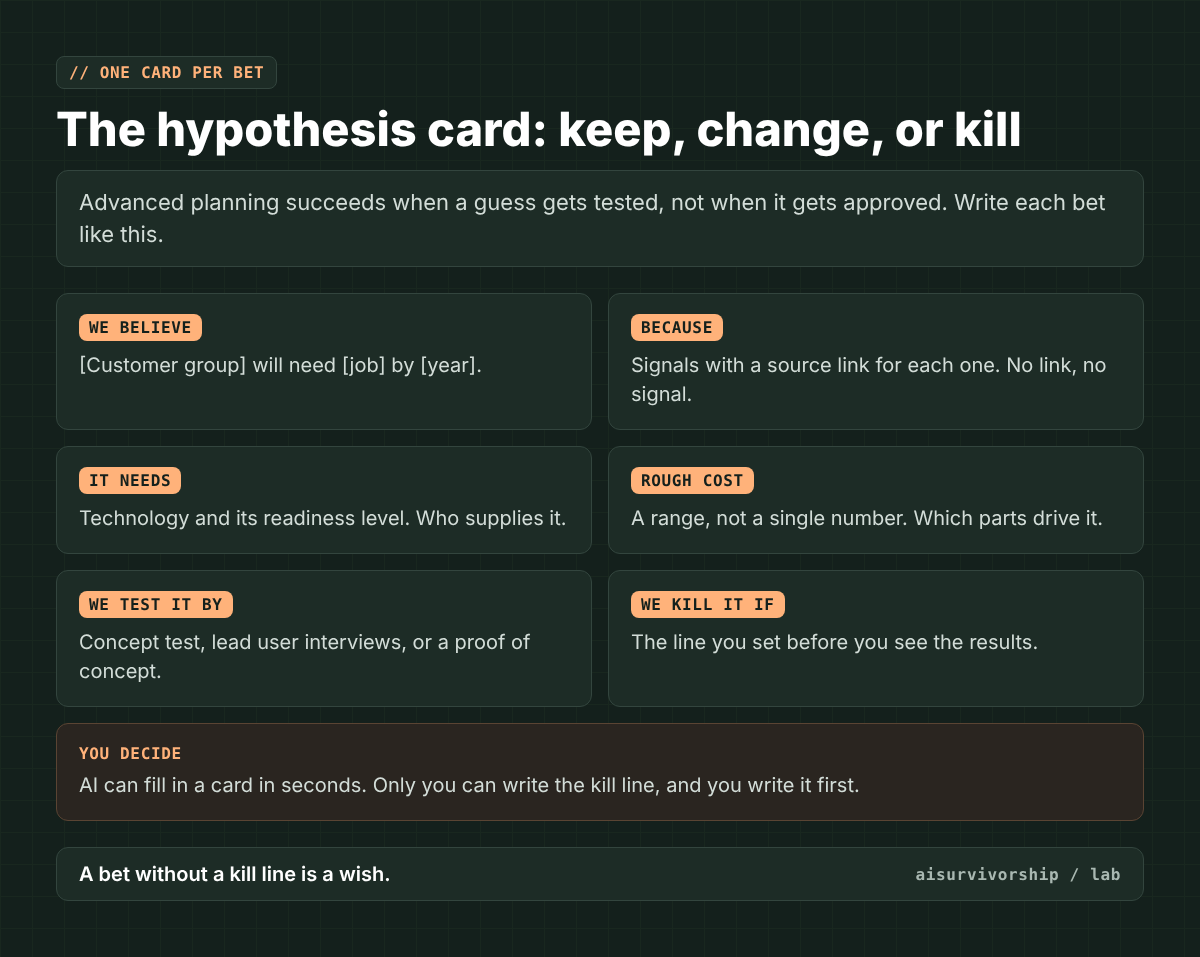
This prompt turns a rough idea into a hypothesis card and makes the AI show a source for every claim. To use it:
- Copy the prompt in the gray box into ChatGPT, Claude, Gemini, or whichever AI chat you use. One with web search works best.
- Fill in the brackets with your product area, customer, and year, then delete the brackets.
- Send it, then open every link. If a source doesn’t say what the AI claims, cut that signal.
- Write the kill line yourself. The prompt leaves it blank on purpose.
- Save the card. You’ll need it when you run the test.
If the AI says it couldn’t find a source, take that at face value. It’s a gap to research, not a fact.
Prompt: Hypothesis card (fill in the brackets)
I am doing advanced product planning, looking 2 to 3 years ahead.

Product area: [e.g., reusable kitchen storage]
Customer group: [who might need this]
Target year: [e.g., 2029]
My rough idea: [one or two sentences]

Draft a hypothesis card with these fields:
1. We believe: [customer group] will need [job] by [year].
2. Because: 3 to 5 signals. For each, give the source name and link. If you cannot find a source, write "NO SOURCE FOUND". Do not guess.
3. It needs: the key technologies, and how mature each one seems today, with a source.
4. Rough cost drivers: which parts or steps would drive cost. No numbers unless sourced.
5. We test it by: 2 cheap tests (e.g., lead user interviews, a concept test).
6. We kill it if: leave this blank. I will write it.

Then list the 3 weakest points in this card.
Worked example (fictional data)
Everything in this example is made up for illustration. The shop, the idea, the costs, and the results aren’t from a real project.
Fictional shop: a two-person online store that sells reusable lunch boxes.
Rough idea for Y+2: a lunch box lid that shows whether food has stayed cold enough.
| Card field | Fictional entry | What the human did |
|---|---|---|
| We believe | Parents packing lunches will want proof that food stayed cold by [year]. | Narrowed it from “everyone” to one group. |
| Because | AI listed four signals. Two links didn’t support the claim. | Deleted those two. Kept two with real sources. |
| It needs | A small temperature sensor and display in a dishwasher-safe lid. | Asked a supplier what has actually been tested, not what’s planned. |
| Rough cost | Three supplier quotes gave a wide range for the lid. | Kept the range. Didn’t average it into one neat number. |
| We test it by | A one-page concept shown to 10 lead users (parents who already use ice packs and thermometers). | Picked who to ask. |
| We kill it if | Fewer than 3 of 10 would switch from their current box. | Wrote this before the test. |
Look at the Because row. The first draft looked finished. Two of the four links didn’t say what the AI claimed they did, and catching that took a few minutes of clicking. Mistakes don’t get much cheaper than that.
Checklist
☐ You opened every source yourself.
☐ The idea names one customer group and one year.
☐ You know how ready each key technology is, and who says so.
☐ Cost is a range, not a single number.
☐ At least one cheap test comes before any big spend.
☐ The kill line was written before the test.
☐ Small sellers: no more than three bets on the roadmap at once.
Guides in this track
Each step gets its own guide over the next two weeks. Links go up here as they’re published.
- Researching customers you don’t have yet: trend signals and lead users with AI
- PEST analysis with AI: scanning trends three years out
- 3C analysis with AI: customer, competitor, and company on one page
- Market sizing with AI: TAM, SAM, and SOM you can defend
- Future customer personas and the value proposition canvas with AI
- How to read a supplier technology roadmap as a product planner
- TRL and SOP: is this technology ready for your launch?
- Build, buy, or partner? PoC and joint development explained
- How to estimate rough COGS for a new product concept
- Concept testing with AI: write the survey, read the results
- Future-state customer journey maps
- How to build a three-year product roadmap from technology and trend inputs
Working on a product that’s already selling? The current planning hub covers that track.
Limits
- Nothing here predicts the future. The loop just makes being wrong cheaper.
- AI tools invent sources and misread real ones. Until you’ve opened the link, any number or trend from AI is unverified.
- The readiness scale above is simplified. NASA wrote the full definitions for space missions, so you’ll need to translate them for your product.
- Big companies split this work in very different ways depending on industry. The version here is one common setup, not a standard.
- Partnerships and development agreements are legal contracts. This guide isn’t legal advice.
- Don’t paste confidential supplier roadmaps or internal plans into an AI tool unless your company allows it.
FAQ
What is advanced product planning?
The part of product planning that decides what to build two to three years out. You work from trends, future customers, and technology that isn’t ready yet, and turn them into bets you can test.
How is it different from current (lifecycle) planning?
Current planning improves products that are already selling, so it runs on real data like reviews and sales. Advanced planning has no such data. It runs on signals, which is why testing cheaply matters so much.
Can a small business do advanced planning?
Yes. One afternoon a quarter, a short list of sourced signals, a few conversations with lead users, and a one-page roadmap. That’s the whole thing.
What does TRL mean?
Technology readiness level, NASA’s nine-step scale for how mature a technology is. Level 1 is early research. Level 9 is proven in real use.
Can AI forecast which products will win?
No. It’ll widen your search and draft hypotheses quickly, but it can’t tell a good bet from a bad one, and it sounds equally sure about both.
Where this fits: This is the advanced planning track hub of the product planning process series.
Next in this track: future customer personas and the value proposition canvas with AI. New here? Start with researching customers you don’t have yet, the first guide in the track.
Your turn: Where does long-range planning fall apart for you? Finding signals you trust, guessing whether a technology will be ready, or getting anyone to commit to a bet? Leave a comment. We read them, and they decide what we write next.