
QUICK ANSWER
A 3C analysis looks at three things together: your customers, your competitors, and your own company. For a product two to three years out, ask one question per C about that future year, let AI gather facts with a source on every line, and research each C in its own chat so the answers don’t blur. Then do the part AI can’t: find the overlap where a customer need, a real strength of yours, and a competitor’s weak spot meet. Write that overlap down as a guess you can test, not as a conclusion.
Where this sits on the map: Advanced planning track (Y+2 to Y+3) · Market and environment scan (3C). See the advanced planning hub for the full track.
On this page
- What 3C is
- Why three years out changes the method
- Five steps with AI
- Copy-and-paste prompts: 3C research and finding the opening
- 3C analysis example (fictional)
- Limits
- FAQ
What 3C is
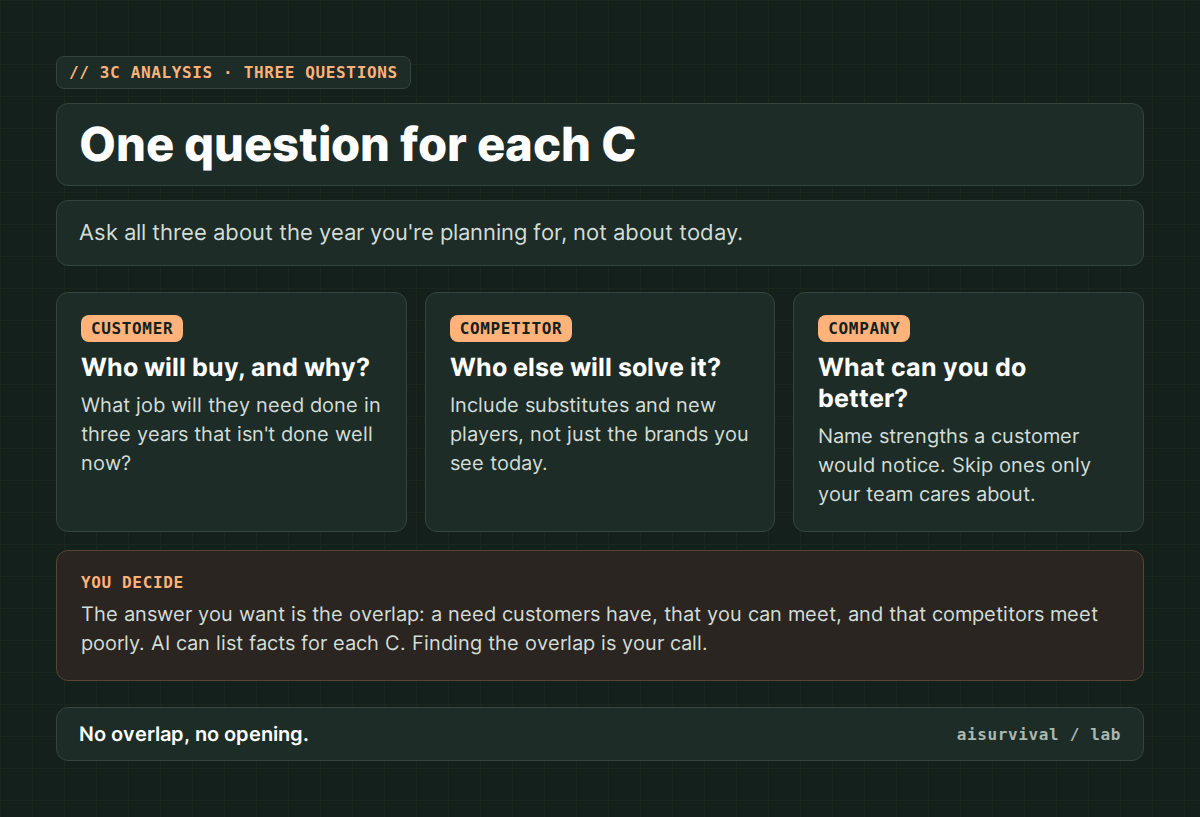
The 3C model comes from Japanese strategist Kenichi Ohmae, who laid it out in his 1982 book The Mind of the Strategist (MindTools). His argument was that any business strategy has to account for three players at the same time: the customer, the corporation, and the competition.
He didn’t treat them as equals, though. Ohmae put the customer first. In his view, a customer-based strategy is the base the other two stand on (Value Based Management). That order is worth keeping when you use AI, because AI is happy to start with a competitor table and never get around to the customer.
If you read the PEST guide, here’s how the two fit. PEST scans the big forces outside your market. 3C zooms in on the market itself. Run PEST first, then carry the factors that matter into your customer and competitor boxes.
Why three years out changes the method
Most 3C templates online describe today: today’s buyers, today’s rivals, today’s strengths. That’s fine for this year’s plan. For a product that launches in 2029, it misses the point.
So give every box two columns, today and three years out, and spend most of your time on the gap between them. The competitor that hurts you in three years often isn’t in your category yet. It’s a substitute, a company from a nearby market, or a habit that makes your product unnecessary.
Five steps with AI
Step 1: Reuse your frame
Use the same one-sentence frame from your PEST scan: product area, market, and year. Same frame, same boundaries. If the two analyses use different years or markets, they won’t connect.
Step 2: Customer first
Ask what job customers will need done in the target year, and what’s changing in how they do it. Feed AI your checked PEST rows and anything you learned from lead user research. Those are the closest thing you have to evidence about future customers.
Step 3: Competitors, wider than you think
Ask AI for four groups: direct competitors, indirect ones, substitutes, and possible new entrants. Every name needs a public source. Open each one. Stick to pages anyone can see, like product pages, press releases, and public reviews. Don’t pull data from behind a login.
Step 4: Your company, honestly
This box is yours to fill. AI doesn’t know your costs, your suppliers, or what your team is good at. Write the list yourself, then use AI as a critic: paste it in and ask which strengths a customer would never notice. Those don’t count. A strength only matters if it shows up in the product or the price.
Step 5: Find the overlap and write it as a guess
Put all three boxes on one page. Look for a need customers will have, that you can meet, and that competitors meet poorly. That’s your opening. Write it as a hypothesis with a way to test it. AI can suggest candidates, but picking one is a judgment call about risk, and that’s your call.
Large company: a planning team builds a full 3C with market research data, competitor teardowns, and input from sales and engineering.
Small seller: one page, three rows, two columns. If the opening doesn’t fit in one sentence, it isn’t clear yet.
Copy-and-paste prompts: 3C research and finding the opening
Two prompts, with your own checking in between. To use them:
- Run Prompt 1 three times, once per C, each in a new chat. Turn on web search if your AI chat has it.
- Open every source and delete rows that fail. For the Company run, replace AI’s guesses with your own facts.
- Open a new chat and run Prompt 2 with only the checked rows.
- Pick one opening and write the test you’ll run first.
Tip: if an opening in Prompt 2 relies on a strength you didn’t list, cross it out. AI made that strength up.
Prompt 1: Research one C (fill in the brackets)
I am planning products for [year, e.g., 2029].
Product area: [e.g., reusable lunch boxes]
Market: [e.g., online sales in the US]
This chat covers only: [CUSTOMER or COMPETITOR or COMPANY]

Make a table with these columns:
Item | Today (one sentence) | In [year] (one sentence) | Source link | What the source says

Rules:
1. Give up to 8 items.
2. For COMPETITOR, include direct competitors, indirect ones, substitutes, and possible new entrants. Label each.
3. Every row needs a source link. If you cannot find one, write NO SOURCE. Do not make up a link.
4. Do not include a number unless it appears on the source page.
5. For COMPANY, only list what I tell you. Ask me questions instead of guessing.
6. Do not give advice yet.
Prompt 2: From a checked 3C sheet to openings (fill in the brackets)
I am planning products for [year].
Product area: [ ]
Market: [ ]

Below is my 3C sheet. I checked every row myself.
CUSTOMER rows: [paste]
COMPETITOR rows: [paste]
COMPANY rows: [paste]

Find up to 3 openings. An opening is a customer need in [year] that my company can meet and that competitors meet poorly.

For each opening, give:
1. One-sentence opening
2. Based on: the exact rows it uses from each C
3. Why competitors leave it open: one sentence
4. Biggest risk: one sentence
5. Cheapest test: one thing I could try in the next 90 days
6. Assumptions: anything you assumed that I did not tell you

Rules:
- Use only the rows I pasted. Do not add new facts, numbers, or sources.
- Every opening must use at least one row from each C. If it does not, drop it.
- If fewer than 3 real openings exist, give fewer and say why.
3C analysis example (fictional data)
Everything in this example is made up for illustration. The shop, the customers, and the competitors aren’t real.
Fictional shop: the same two-person lunch box store from the PEST guide. Frame: reusable lunch boxes, sold online in the US, for 2029. The PEST scan flagged more people batch cooking for the week. Here’s what the 3C sheet looked like once it was checked.
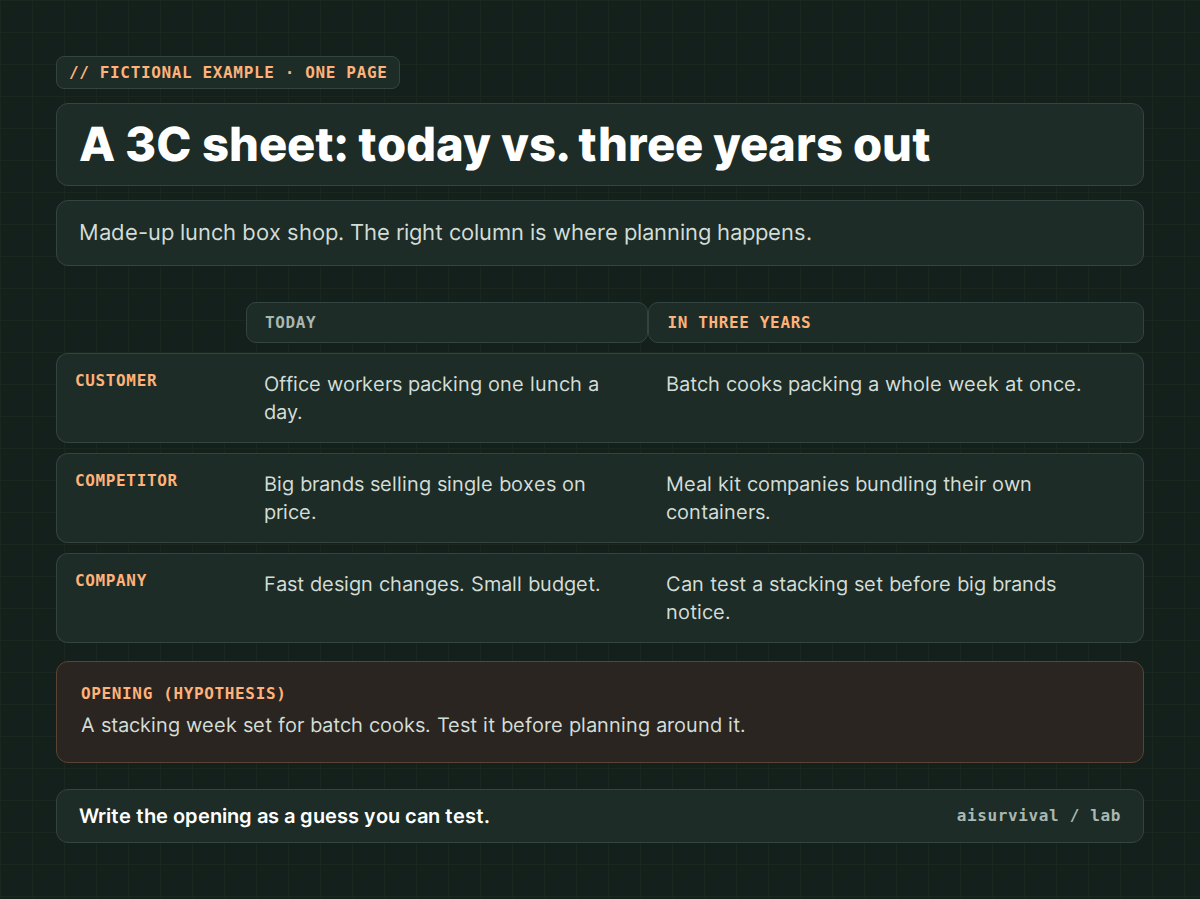
Notice the competitor row. Today the threat is big brands on price. In three years the shop expects meal kit companies to bundle their own containers, which is a different fight. A today-only 3C would have missed it.
The opening, a stacking week set for batch cooks, isn’t a plan yet. It’s a guess. The next question is whether that market is big enough to bother with, which is exactly what market sizing answers.
Quick checklist:
☐ All three Cs use the same product area, market, and year.
☐ The customer box was filled first.
☐ Competitors include substitutes and new entrants, not just today’s brands.
☐ Every customer and competitor row has a source someone opened.
☐ Company strengths are ones a customer would notice.
☐ The opening is one sentence, with a test attached.
Limits
- 3C ignores the wider world. Rules, prices, and technology shifts belong in PEST, so run both.
- AI knows big, well-covered competitors best. Small or new ones are easy to miss, and they’re often the ones that matter three years out.
- The company box is only as honest as you are. AI can’t check it for you.
- Public information lags. A competitor’s next product usually isn’t on its website yet.
FAQ
What does 3C stand for?
Customer, competitor, and company (Ohmae called the last one the corporation). Together they’re sometimes called the strategic triangle.
What’s the difference between 3C and SWOT?
SWOT sorts what you find into strengths, weaknesses, opportunities, and threats. 3C sorts it by who it’s about. Many planners do 3C first to gather the facts, then use SWOT to sum them up.
Can I use ChatGPT or Claude for a 3C analysis?
Yes, for customer and competitor research, as long as every row has a source you open yourself. For the company box, use AI only as a critic of a list you wrote.
How often should I update it?
Whenever a new competitor or substitute shows up, and at least once a year alongside your PEST scan.
Where this fits: Advanced planning track · Market and environment scan, part of the product planning process series. Previous guide in this track: PEST analysis with AI.
Next in this track: market sizing with AI, so you can tell whether your opening is worth chasing. Subscribe if you’d like it in your inbox.
Your turn: Which C is hardest to fill in for your product? Tell us in the comments. We’ll use the answers to pick examples for future guides.