
QUICK ANSWER
A value proposition canvas has two sides. The customer profile lists what one customer segment is trying to get done (jobs), what gets in the way (pains), and what they hope for (gains). The value map lists your products, how they relieve those pains, and how they create those gains. You have a fit when your offer answers the pains and gains that matter most. AI is great for drafting the customer side quickly. But an AI persona is a guess, not a customer, so rank the pains yourself and check the top one with real people before you build anything.
Where this sits on the map: Advanced planning track (Y+2 to Y+3) · Value proposition. See the advanced planning hub for the full track.
On this page
- The value proposition canvas in plain words
- Why “future” personas are different
- Where AI helps, and where it makes things up
- Five steps with AI
- Copy-and-paste prompts
- Value proposition canvas example (fictional)
- Limits
- FAQ
The value proposition canvas in plain words
Alexander Osterwalder introduced the canvas as a plug-in to the Business Model Canvas. It zooms in on just two of its blocks, the customer segment and the value proposition, so you can see whether they actually match (Strategyzer). The full method is in the book Value Proposition Design (Wiley, 2014).
The right side is the customer profile:
- Customer jobs: what they’re trying to get done. Not just practical tasks. Strategyzer also counts social jobs (how they want to look to others) and emotional jobs (how they want to feel).
- Pains: anything that annoys them before, during, or after the job. Cost, effort, risk, a current product that underperforms.
- Gains: the outcomes they want, from the ones they expect to the ones that would surprise them.
The left side is the value map: your products and services, the pain relievers (how the offer removes specific pains), and the gain creators (how it delivers specific gains).
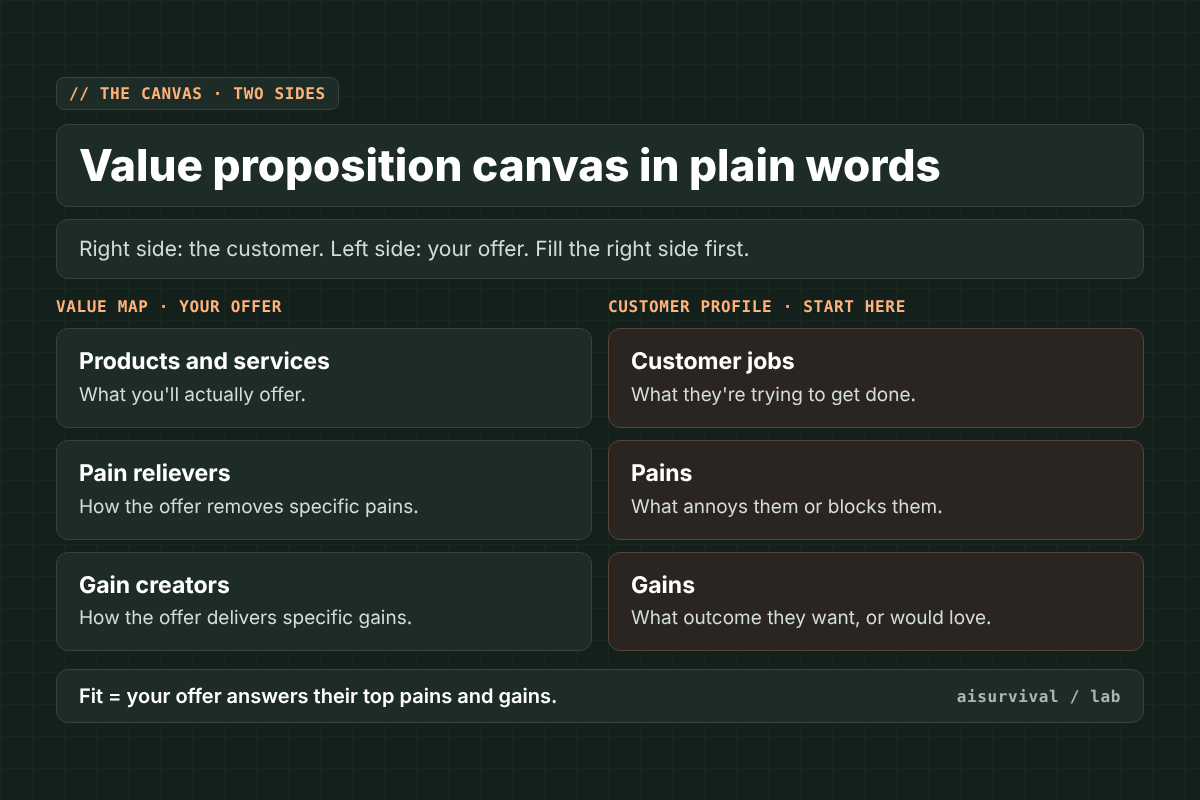
Always fill the right side first. If you start with your product, every pain you write down will magically be one your product solves.
Why “future” personas are different
On the current planning track, you have real customers. You can read their reviews and support tickets and build a persona from what they actually said.
Two to three years out, that customer may not exist yet. Or they exist, but they don’t buy your kind of product today. So a future persona is a hypothesis about a person. It should be built from the signals you already gathered: the trends from your PEST scan, the people already hacking their own solutions from your lead user research, and the segment you sized in your market sizing.
Lead users matter most here. They often feel tomorrow’s pains today. Talking to three of them is worth more than any persona a chatbot can invent.
Where AI helps, and where it makes things up
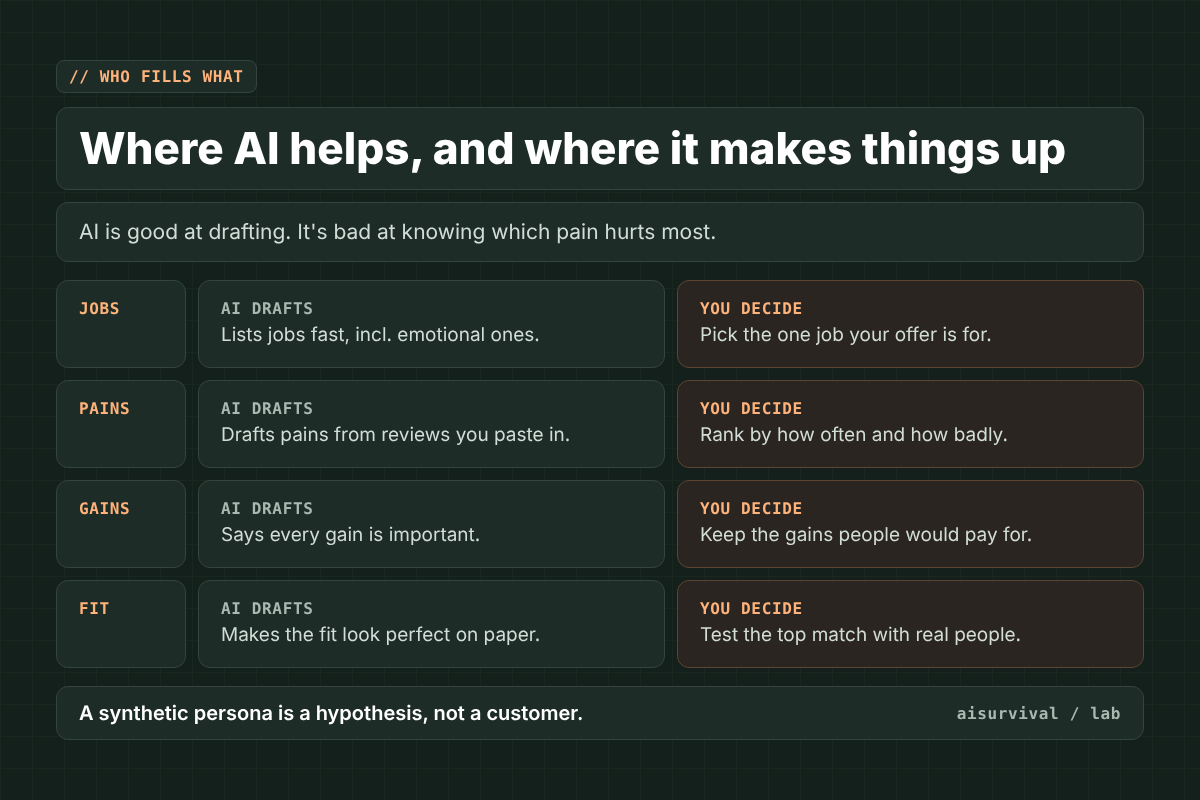
AI is fast at the blank-page part. Ask it for customer jobs and it’ll list 20, including emotional ones you’d never think of. Paste in public reviews or forum posts and it’ll sort them into pains and gains in seconds.
What it can’t do is tell you which pain actually hurts. Nielsen Norman Group compared AI-generated “synthetic users” with real research participants and found that synthetic users seem to care about everything, which makes them a poor basis for prioritizing features or creating personas. In one of their studies, synthetic users said they’d finished all their online courses. Real people hadn’t. AI also tends to like every idea you show it, so it’s risky for testing concepts.
NN/g does see a use: synthetic users as a starting point for hypotheses and for preparing real research. That’s exactly the role to give AI here.
Five steps with AI
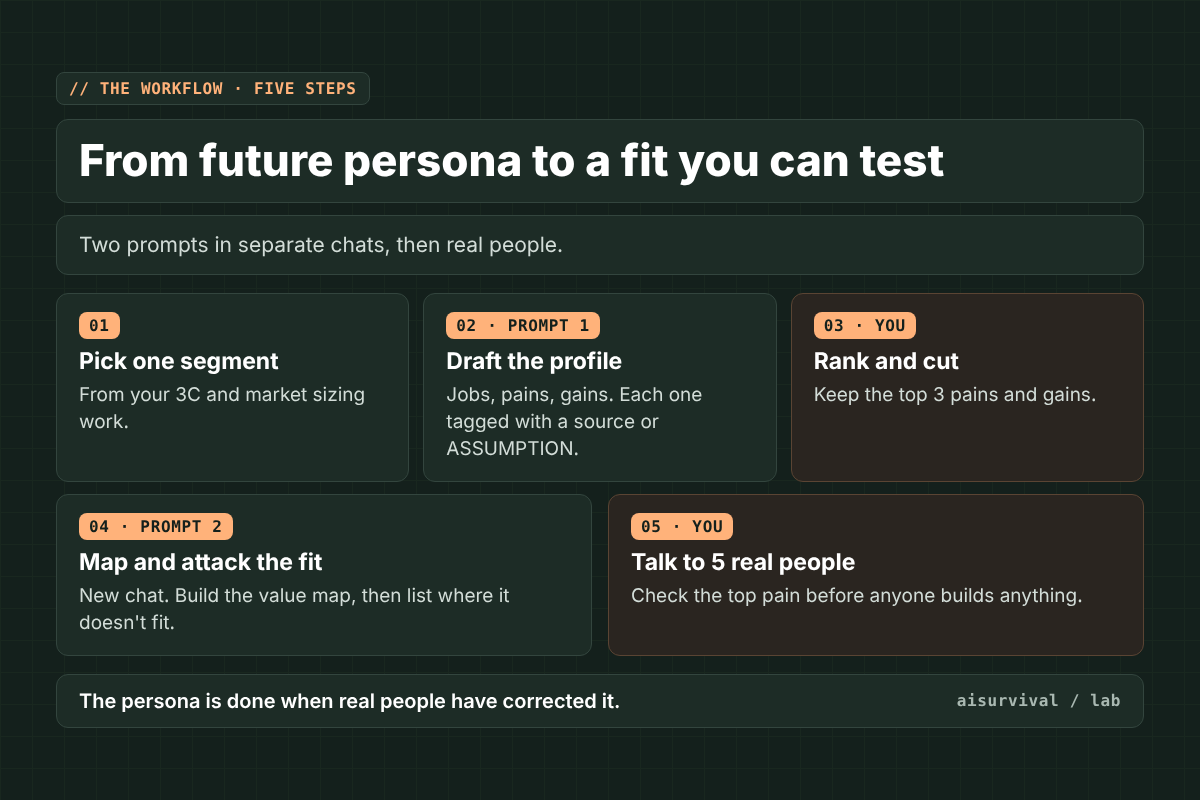
Step 1: Pick one segment
One canvas, one segment. If your 3C analysis found two promising groups, make two canvases. Mixing them gives you a persona who wants everything and buys nothing.
Step 2: Draft the customer profile with AI
Give AI the segment, the year, and the evidence you already have. Ask for jobs, pains, and gains, and make it tag each line with a source or the word ASSUMPTION. That tag is the whole point. It shows you how much of the persona is real.
Step 3: Rank and cut
This one’s yours. Strategyzer suggests ranking pains by how intense and how frequent they are, and gains by how relevant they are. Keep the top three of each. A canvas with 30 sticky notes on the right side isn’t thorough. It’s undecided.
Step 4: Map the offer, then attack the fit
Now fill the left side. Then open a new chat and ask AI to find where the offer doesn’t fit. A fresh chat won’t defend the map it didn’t write.
Step 5: Talk to five real people
Take the top pain to five people in the segment, ideally lead users. Don’t pitch. Ask when it last happened and what they did about it. If nobody can remember the last time, it isn’t a top pain.
Large company: a planning team runs the canvas in a workshop with design and engineering, then funds a round of interviews or a concept test.
Small seller: one canvas on one page, and five conversations. That’s enough to decide whether an idea deserves a prototype.
Copy-and-paste prompts
Use two separate chats. Run Prompt 1, rank and cut the result yourself, then paste your short version into Prompt 2.
Prompt 1: Draft a future customer profile (fill in the brackets)
I am planning a product for [year].
Customer segment: [e.g., US households that batch cook for the week]
Evidence I already have: [paste trend notes, lead user quotes, public reviews]

Draft a customer profile for a value proposition canvas.

1. Customer jobs: functional, social, and emotional. Up to 8.
2. Pains: up to 8. For each, say when it happens (before, during, or after the job).
3. Gains: up to 8, from expected to surprising.

Rules:
- Tag every line with the evidence it comes from, or the label ASSUMPTION.
- Do not invent quotes, statistics, or sources.
- Do not mention any product or solution. Describe the customer only.
- End with the 3 assumptions I should check first with real people.
Prompt 2: Attack the fit (new chat)
Below is a value proposition canvas someone else made. Act as a skeptical customer from this segment.

Customer profile (ranked): [paste your top 3 jobs, pains, and gains]
Value map: [paste products, pain relievers, gain creators]

1. For each top pain and gain, say FIT, WEAK, or GAP, and why in one sentence.
2. List any pain reliever or gain creator that answers a pain nobody listed.
3. Name the single claim in this offer a real customer is most likely to doubt.
4. Suggest 3 interview questions about past behavior (not opinions) to test the top pain.

Do not add new customer facts. Only judge what is here.
Value proposition canvas example (fictional data)
Everything here is made up for illustration.
Fictional shop: the two-person lunch box store from the 3C guide and the market sizing guide. Segment: US households that batch cook for the week, in 2029.
Prompt 1 returned 22 lines, and 15 were tagged ASSUMPTION. After ranking, the shop kept this:
| Customer profile | Top items (fictional) |
|---|---|
| Job | Prep five lunches on Sunday and grab one each morning without thinking. |
| Pains | Lids crack in the dishwasher. Boxes don’t stack in a small fridge. Lunch leaks in a work bag. |
| Gains | The fridge looks organized. Less money spent on takeout. |
Then a lead user interview added one more pain the AI draft had missed: plastic starts to smell after a few months. Prompt 2 checked the offer, a stacking week set, against all four.

Two clear fits, one weak spot, one gap. Notice the gap came from a real person, not from AI. That’s the pattern to expect. The shop’s next step isn’t building. It’s asking five batch cooks when their lids last cracked, and whether the smell bothers anyone else.
Quick checklist:
☐ One segment per canvas.
☐ The customer side was filled before the offer side.
☐ Every line has a source or says ASSUMPTION.
☐ You ranked and kept only the top three pains and gains.
☐ A fresh chat looked for where the offer doesn’t fit.
☐ Real people confirmed the top pain.
Limits
- An AI persona is built from patterns in text, not from your customers. Never present it as research.
- AI does worst with niche groups where little public data exists. Expect more ASSUMPTION tags there.
- A fit on paper isn’t product-market fit. It just tells you what to test next.
- Don’t paste private customer data or confidential company information into a public AI tool.
FAQ
What are the six parts of the value proposition canvas?
Customer jobs, pains, and gains on the customer profile side. Products and services, pain relievers, and gain creators on the value map side.
Which side of the canvas should I fill in first?
The customer profile. If you start with your product, you’ll describe the customer you wish you had.
Can AI create customer personas?
It can draft them quickly, and that’s a good place to start. But AI personas tend to say every need is important, so use them as hypotheses and check the top pain with real people.
What’s the difference between the value proposition canvas and the Business Model Canvas?
The Business Model Canvas maps the whole business on one page. The value proposition canvas zooms in on two of its blocks, the customer segment and the value proposition, to check that they match.
Where this fits: Advanced planning track · Value proposition, part of the product planning process series. Previous guide in this track: market sizing with AI.
Next in this track: how to read a supplier technology roadmap. Subscribe if you’d like it in your inbox.
Your turn: Which pain did your last AI persona get wrong? Tell us in the comments. We’ll use the answers to shape future guides.