
QUICK ANSWER
When you plan a product two or three years out, most of its future customers don’t feel the need yet. A few already do. They’re called lead users: people who face tomorrow’s need today and have a strong reason to solve it, so they often build their own fixes. Pick one trend, find the people at its leading edge, study what they’ve rigged up, then check the idea with ordinary customers. AI helps you widen the search and draft questions. It can’t find real people for you, and it can’t prove a trend is real.
Where this sits on the map: Advanced planning track (Y+2 to Y+3) · Customer research (advanced edition). See the advanced planning hub for the full track.
On this page
- Why future customers need a different method
- What a lead user is
- Four steps, with AI’s part in each
- Copy-and-paste prompt: lead user search plan
- Worked example (fictional)
- Limits
- FAQ
Why future customers need a different method
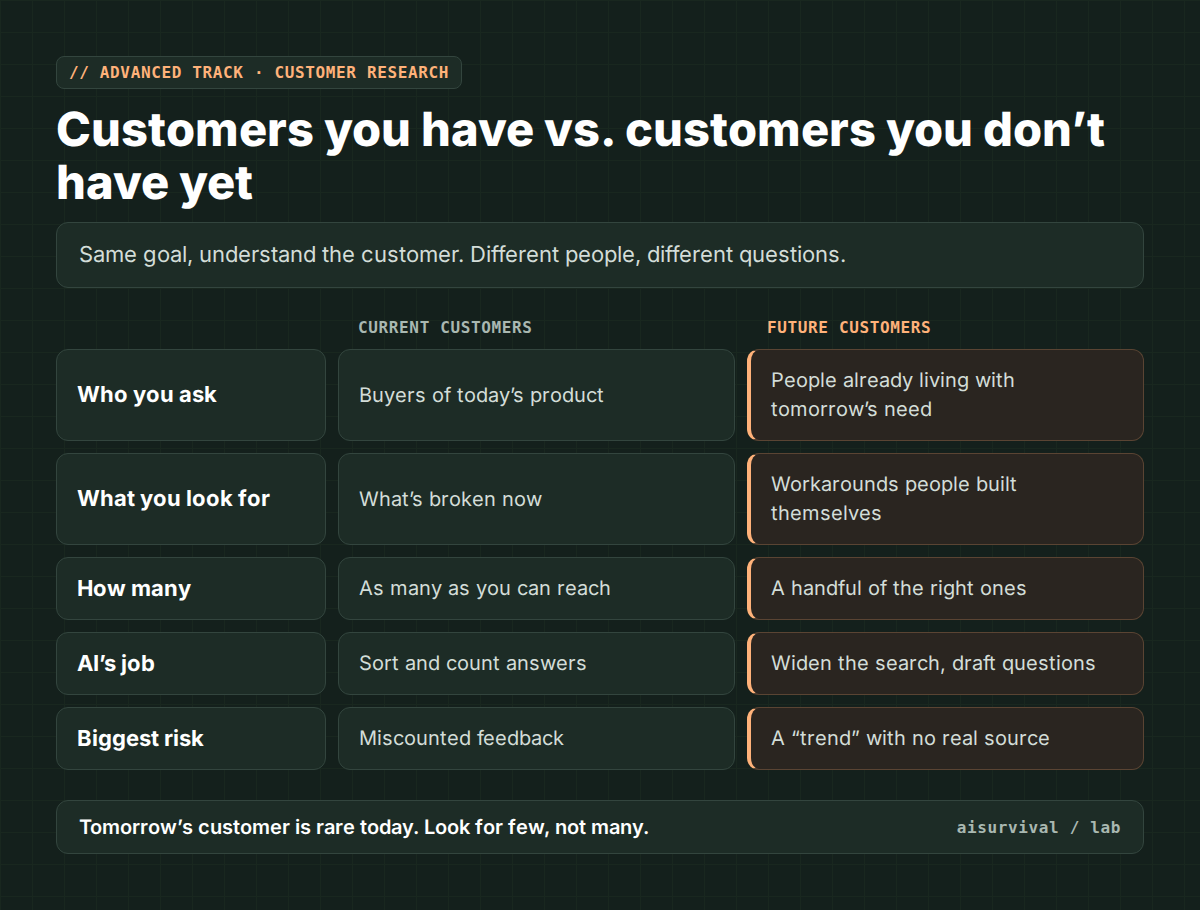
Ask today’s customers what they’ll want in 2029 and you’ll get polite guesses. They answer from what they know now. That’s fine for fixing a product that’s already selling, and it’s why the survey guide sits on the current planning track.
For advanced planning, you want people whose today looks like everyone else’s tomorrow. There aren’t many of them. So instead of asking lots of people, you go looking for a handful of the right ones.
What a lead user is
The idea comes from Eric von Hippel at MIT. Lead users have two traits. They face needs that will become common in a market, but they face them months or years before most of that market does. And they expect to gain a lot from solving those needs (Herstatt and von Hippel).
That second trait is why they so often build things. In one study of firms using circuit board design software, 24.3% had built their own version for their own use (Democratizing Innovation, chapter 2). A homemade fix is the best clue you’ll get.
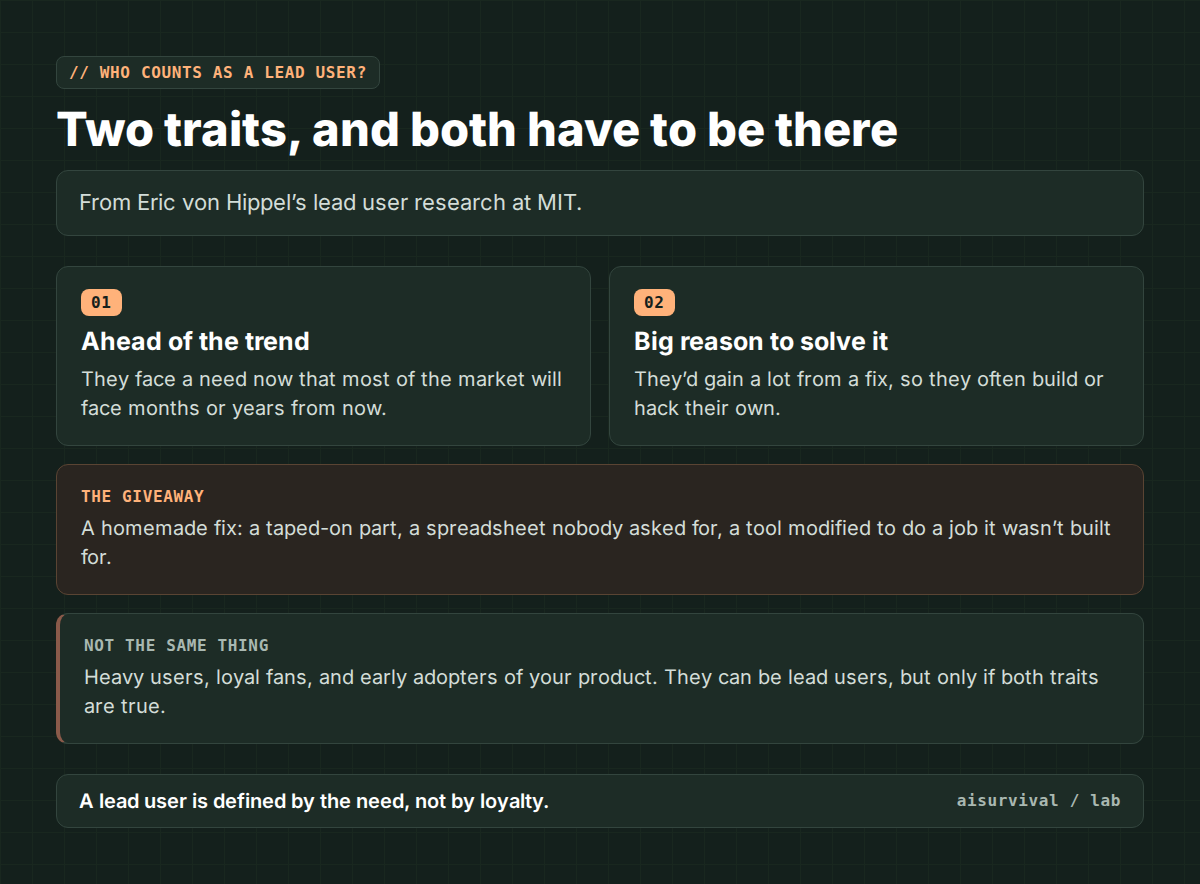
Don’t mix them up with your biggest fans. A loyal customer who buys everything you make might be a lead user. Usually they’re not. The test is the need, not the loyalty.
Four steps, with AI’s part in each
Von Hippel’s method runs in four broad steps: name the trend and what a lead user looks like, find them, work with them on concepts, then test those concepts with typical users (Herstatt and von Hippel). Here’s a lighter version you can run with AI.
Step 1: Pick one trend and prove it’s real
Lead users only lead relative to a trend, so start there. Write the trend as one plain sentence: who is changing, and how. “More people cook once and eat the same meal four times” is usable. “Convenience is rising” isn’t.
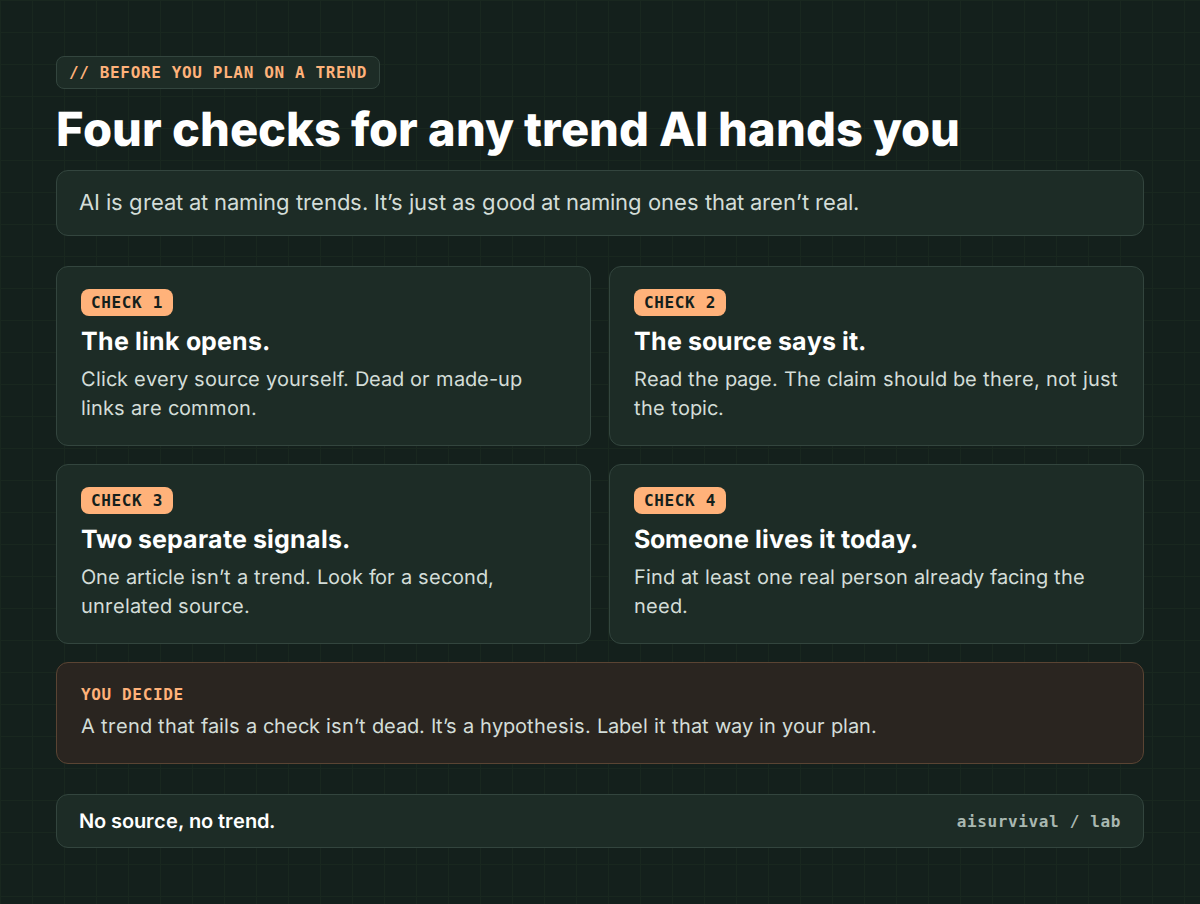
AI is good at listing candidate trends. It’s also good at inventing them, complete with a confident percentage and a source that doesn’t say what it claims. So every trend gets four checks before it goes into a plan.
Step 2: Describe the person you’re looking for
Turn the two traits into signs you could actually spot. Ahead of the trend might mean “already cooks in bulk every week.” Big reason to solve it might mean “eats away from home five days a week, so a leak ruins a work bag.” A homemade fix might be rubber bands around a lid.
Then look sideways. Von Hippel also points to “advanced analog fields,” where people face a related need in a more extreme form (Democratizing Innovation, chapter 10). This is where AI is genuinely useful: ask it for fields where the same need shows up at higher stakes, then judge the list yourself.
Step 3: Find them by asking for referrals
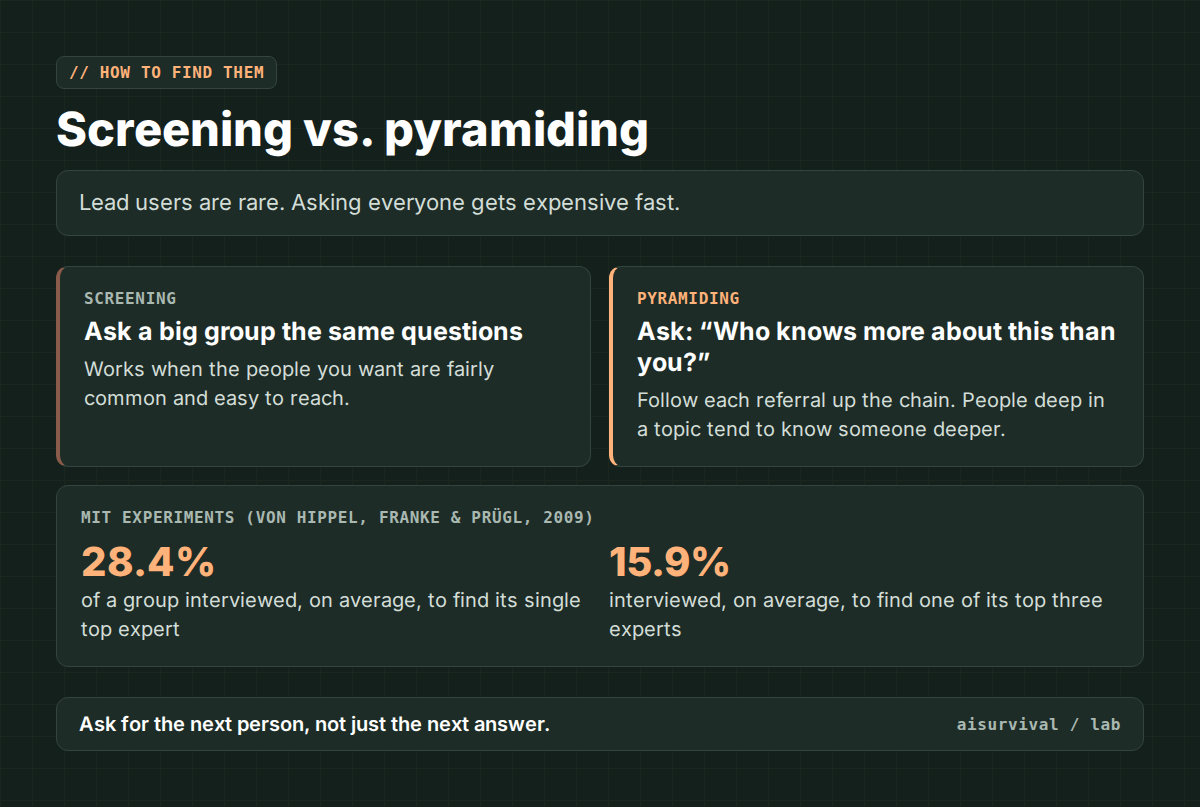
You can screen a big group with the same questions, but that gets expensive when the people you want are rare. The other way is pyramiding: ask each person who knows more about the topic than they do, and follow the chain. In four MIT experiments, pyramiding found the single most expert person in a group after interviewing 28.4% of it on average, and one of the top three after 15.9% (von Hippel, Franke, and Prügl, 2009).
AI can’t do this step. It can suggest where people talk about a topic in public, and it can draft your outreach message. It can’t tell you who the real people are, and anything it says about a named person should be treated as made up. Read public posts, ask before you quote anyone, and offer something for their time.
Step 4: Learn from their fixes, then test with normal customers
In the conversation, skip “what would you want?” Ask what they’ve already tried, built, or given up on, and why. Their workarounds are your first concept drafts.
Then go back to typical customers. Lead users are useful precisely because they’re not typical, so a concept they love can still leave the mainstream cold. Show the concept to ordinary buyers before it goes on a roadmap.
Large company: a cross-functional team spends weeks on trend research, runs pyramiding interviews across industries, and holds a concept workshop with a few lead users.
Small seller: one trend, three to five conversations found through referrals, and a quick check with five regular customers. A month of evenings, not a project.
Copy-and-paste prompt: lead user search plan
This prompt turns one trend into a search plan and keeps the AI from inventing people or numbers. To use it:
- Write your trend as one plain sentence, and paste any source links you’ve already checked.
- Copy the prompt in the gray box into ChatGPT, Claude, Gemini, or whichever AI chat you use, and fill in the brackets.
- Check every line marked [NEEDS SOURCE] yourself, or cross it out.
- Pick two analog fields from the list that you can actually reach.
- Use the questions in your first conversation, and end every one with the referral question.
Tip: if the answer names a specific person or a community size, delete it. You’ll find real people through referrals, not through a chatbot.
Prompt: Lead user search plan (fill in the brackets)
I am planning a product for two to three years from now and want to find lead users: people who already face a need most of the market will face later, and who gain a lot from solving it.

Product area: [e.g., lunch boxes and meal containers]
Trend (one sentence): [e.g., more people cook once and eat the same meal four times]
Sources I have checked: [paste links, or write "none yet"]

Do this:
1. List 5 signs that someone is AHEAD of this trend, and 5 signs that they have a BIG REASON to solve it.
2. List 5 homemade fixes or workarounds a lead user might already be using.
3. List 4 analog fields where the same need shows up in a more extreme form, with one line on why.
4. List places where people discuss this in public, by type (e.g., hobby forums, trade groups). Do not name specific people.
5. Write 6 interview questions about what they have already tried, built, or given up on. The last question must ask who they know that is even further ahead.

Rules: Do not invent people, numbers, or community sizes. Mark any factual claim about the market [NEEDS SOURCE] unless it comes from a link I gave you.
Worked example (fictional data)
Everything in this example is made up for illustration. The shop, the people, and the results aren’t from a real project.
Fictional shop: the same two-person lunch box store from the current planning hub, now thinking about what to sell in three years.
| Step | Fictional finding | What the human decided |
|---|---|---|
| 1. Trend | AI offered seven trends. Two had links that didn’t say what AI claimed. | Kept one with two separate sources: batch cooking for the whole week. |
| 2. Who | Signs: cooks four or more meals at once, eats away from home daily. Analog fields: night-shift workers, long-distance hikers. | Dropped hikers (weight matters more than leaks there). Kept night-shift workers. |
| 3. Find | Started with two regular customers who batch cook. Each named someone “way more intense about it.” | Four referrals later, reached a night-shift nurse who stacks five containers with silicone bands. |
| 4. Learn | Her fix: one lid that seals a stack of shallow trays, so the whole week fits one bag. | Sketched a stacking tray set. Showed it to eight regular buyers: five wanted it, three said it looked bulky. |
Five out of eight isn’t proof, and nobody in the shop pretended it was. The concept goes into the three-year plan as a hypothesis with a next test attached. That’s the honest output of this kind of research.
Quick checklist:
☐ One trend, written as a plain sentence.
☐ Every source opened and read by a person.
☐ Signs for both traits written down before searching.
☐ At least one analog field explored.
☐ Every conversation ended with “who’s further ahead than you?”
☐ The concept was shown to typical customers, not just lead users.
Limits
- Lead users aren’t a representative sample. Their enthusiasm doesn’t measure market size.
- Being ahead on one trend doesn’t mean being ahead on all of them. Pick the trend first.
- The MIT pyramiding numbers come from specific experiments. Your search may take more or fewer conversations.
- AI suggestions about trends, fields, and communities are leads to check, not findings.
- If a lead user shows you something they built, ask before you copy it. A shared idea and permission to use it aren’t the same thing.
FAQ
What is lead user research?
A way to study future needs by finding people who already have them. Lead users face a need before most of the market and gain a lot from solving it, so they often build their own fixes.
How are lead users different from early adopters?
Early adopters are quick to buy new products. Lead users often act before any product exists, because they need a solution badly enough to make one.
Can AI find lead users for me?
No. It can suggest signs to look for, analog fields, and interview questions. Finding and talking to real people is your job.
How many lead users do I need?
Fewer than you think. A small seller can learn a lot from three to five good conversations, as long as the concept is checked with typical customers afterward.
Where this fits: Advanced planning track · Customer research (advanced edition), part of the product planning process series.
Next in this track: PEST analysis with AI, scanning trends three years out with a source check built in.
Your turn: Have you ever seen a customer rig up their own fix for one of your products? Tell us what they built in the comments. Those stories shape what we write next.