
QUICK ANSWER
Score every AI side hustle on five questions before you start: can you see people paying, how much do you keep after fees, how fast is the first dollar, how hard is it to copy, and can one platform shut it down. On that sheet, services that sell your judgment (automation setups, custom tools, slide decks) beat products that AI makes end to end (auto-written blogs, AI books, faceless Shorts). The reason is simple. Anything a prompt can make, the next person’s prompt can make too.
Series: Side Hustle, part 1. Start here: score an idea first, then the rest of the series compares the AI tools for each job.
On this page
- Why score instead of copying a tier list
- The five questions
- 10 AI side hustles, scored
- What the platforms keep
- The copy test
- Copy-and-paste prompt: score your own idea
- What’s next in this series
- Limits
- FAQ
Why score instead of copying a tier list
AI side hustle tier lists are everywhere right now. This post started with one: a Korean creator’s video that ranks AI side hustles from tier 5 to tier 1 (Honjobs on YouTube). It’s a fun format. It also has a problem every tier list has. You get the creator’s answer, not the reasoning you’d need to judge your own situation.
So this post doesn’t copy anyone’s ranking. It does what a product planner does before backing any new product: write the criteria down first, check the numbers that can be checked, and only then rank. The platforms here are the ones US readers actually use, and every fee and rule below links to a source.
One honest note up front. These scores are planning judgments, not income reports. They aren’t based on running all ten businesses. The fees and rules are facts; the 1-to-5 scores are opinions you can argue with, and you should.
The five questions
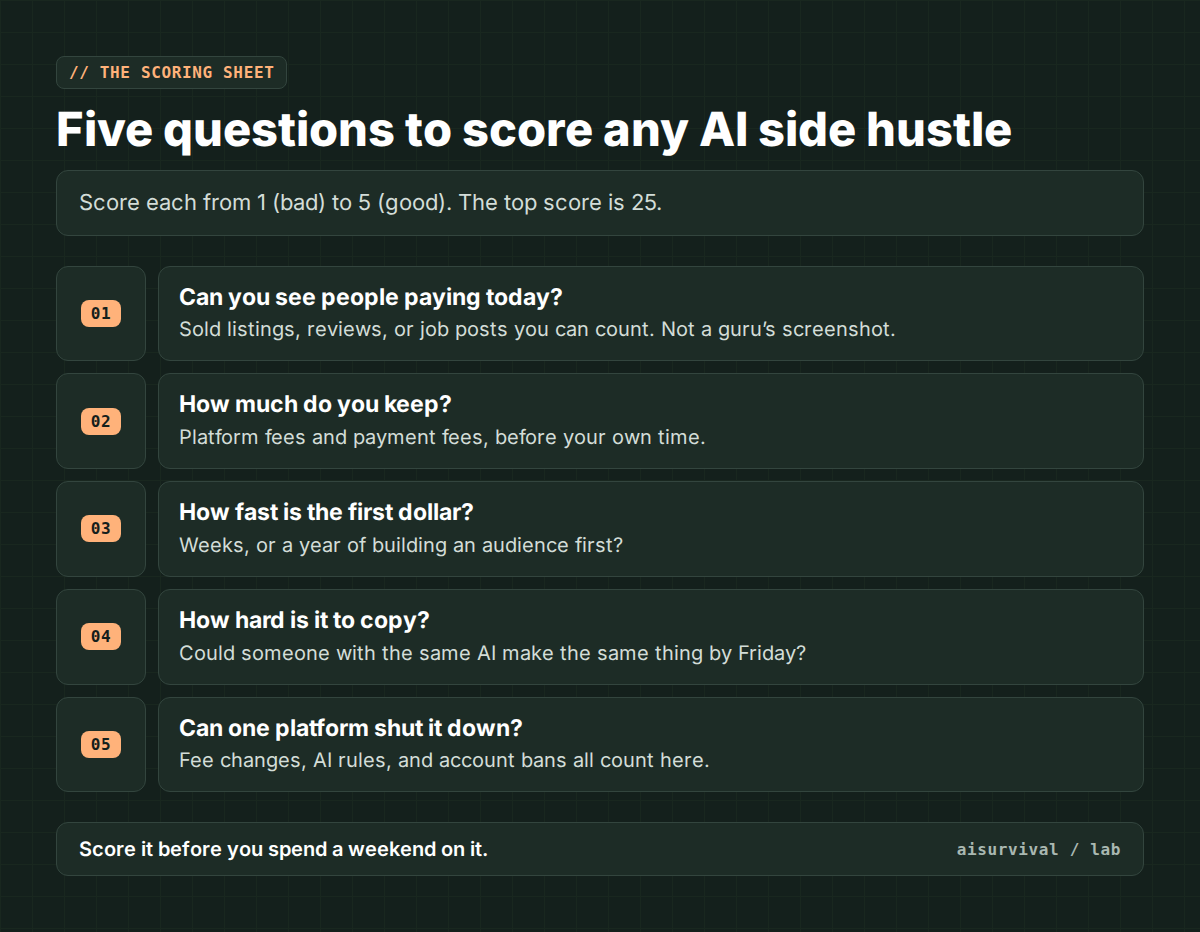
Each question gets a score from 1 to 5, where 5 is good for you. A few notes on how to score them:
- Proven demand means evidence you can count today: sold listings, reviews, posted jobs. A screenshot of someone’s earnings doesn’t count.
- What you keep is about platform and payment fees. Your own time comes later, in question 3.
- Time to first dollar rewards things that can earn in weeks. Anything that needs a big audience first scores low.
- Hard to copy is the question most AI hustles fail. More on that below.
- Platform risk is scored the other way round: 5 means no single company can switch off your income with a policy change.
10 AI side hustles, scored
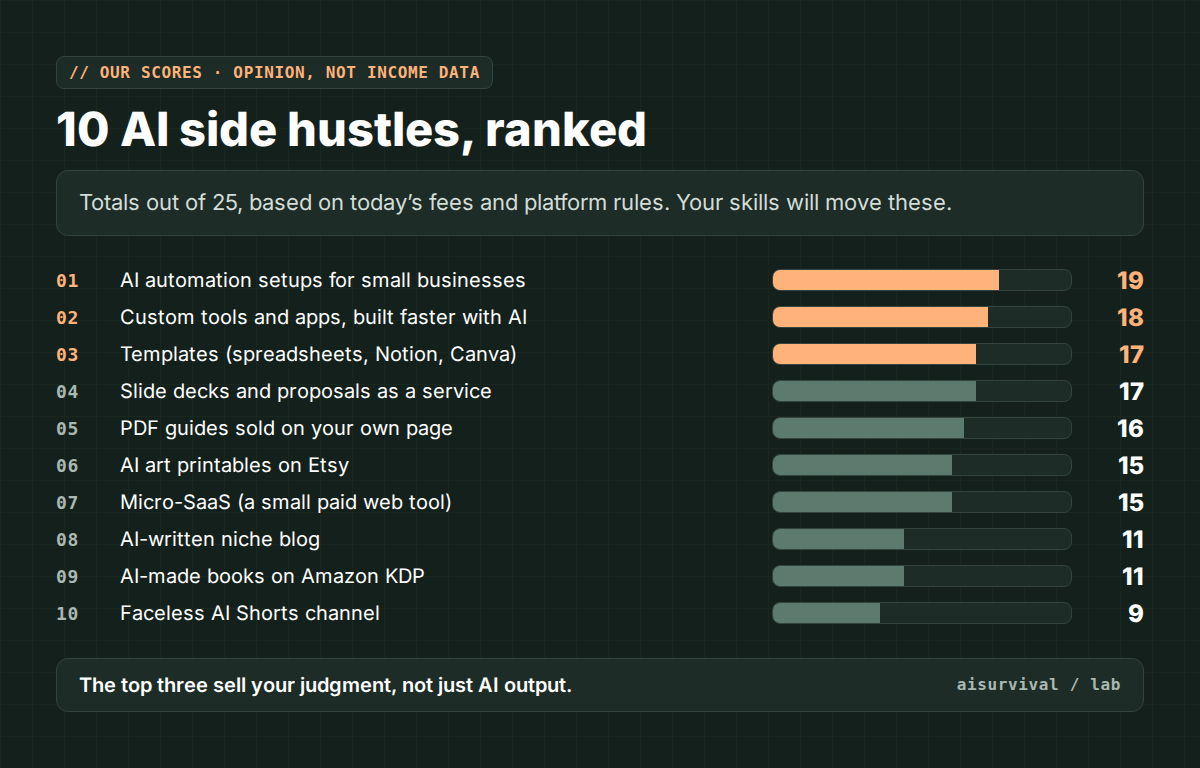
Here’s the full sheet, so you can see where every total comes from. Ties are broken by what you keep.
| Side hustle | Demand | Keep | Speed | Copy | Platform | Total |
|---|---|---|---|---|---|---|
| AI automation setups for small businesses | 4 | 4 | 3 | 4 | 4 | 19 |
| Custom tools and apps, built faster with AI | 4 | 4 | 2 | 4 | 4 | 18 |
| Templates (spreadsheets, Notion, Canva) | 4 | 4 | 3 | 3 | 3 | 17 |
| Slide decks and proposals as a service | 4 | 3 | 4 | 3 | 3 | 17 |
| PDF guides sold on your own page | 3 | 4 | 3 | 3 | 3 | 16 |
| AI art printables on Etsy | 4 | 4 | 4 | 1 | 2 | 15 |
| Micro-SaaS (a small paid web tool) | 2 | 5 | 1 | 3 | 4 | 15 |
| AI-written niche blog | 3 | 4 | 1 | 1 | 2 | 11 |
| AI-made books on Amazon KDP | 3 | 3 | 3 | 1 | 1 | 11 |
| Faceless AI Shorts channel | 3 | 2 | 1 | 1 | 2 | 9 |
Why the top three win
Automation setups score highest because small businesses already pay for the result (fewer hours spent copying data between apps) and every client’s setup is different. AI writes the formulas and scripts. You decide what’s worth automating, and that’s the part they’re paying for.
Custom tools and apps lose a point on speed, since a first project takes longer to land and deliver. They make it back on copy risk: a tool built around one client’s process is hard for anyone else to undercut.
Templates are the best-scoring product. AI speeds up building them, but the value is knowing what a specific niche needs, like a budget sheet for wedding planners rather than “a budget template.” Generic templates score lower on copy risk than this table shows.
Why the bottom three lose
All three have the same weakness: AI does the whole job, so there’s nothing stopping a thousand other people from doing the same job tonight. Then the platform rules make it harder.
AI books on KDP: Amazon requires publishers to disclose AI-generated text, images, and translations, and it says it will reject or remove AI-generated content that creates a disappointing customer experience. It also added limits on how many titles an account can publish (Decrypt). That’s a lot of risk resting on one company.
Faceless AI Shorts: ad revenue needs 1,000 subscribers plus 10 million Shorts views in 90 days, and from February 1, 2027, new applicants will need 20 million (Analytics Insight). YouTube also renamed its “repetitious content” rule to “inauthentic content,” and generic, mass-produced AI videos can fail it. The policy targets low-effort output with no human creative input, not AI use itself (EMARKETER).
AI-written niche blog: it earns from search traffic, which takes months to build, and every competitor has the same writing tool. If the posts say what any chatbot would say, there’s no reason for a reader, or a search engine, to prefer yours.
What the platforms keep
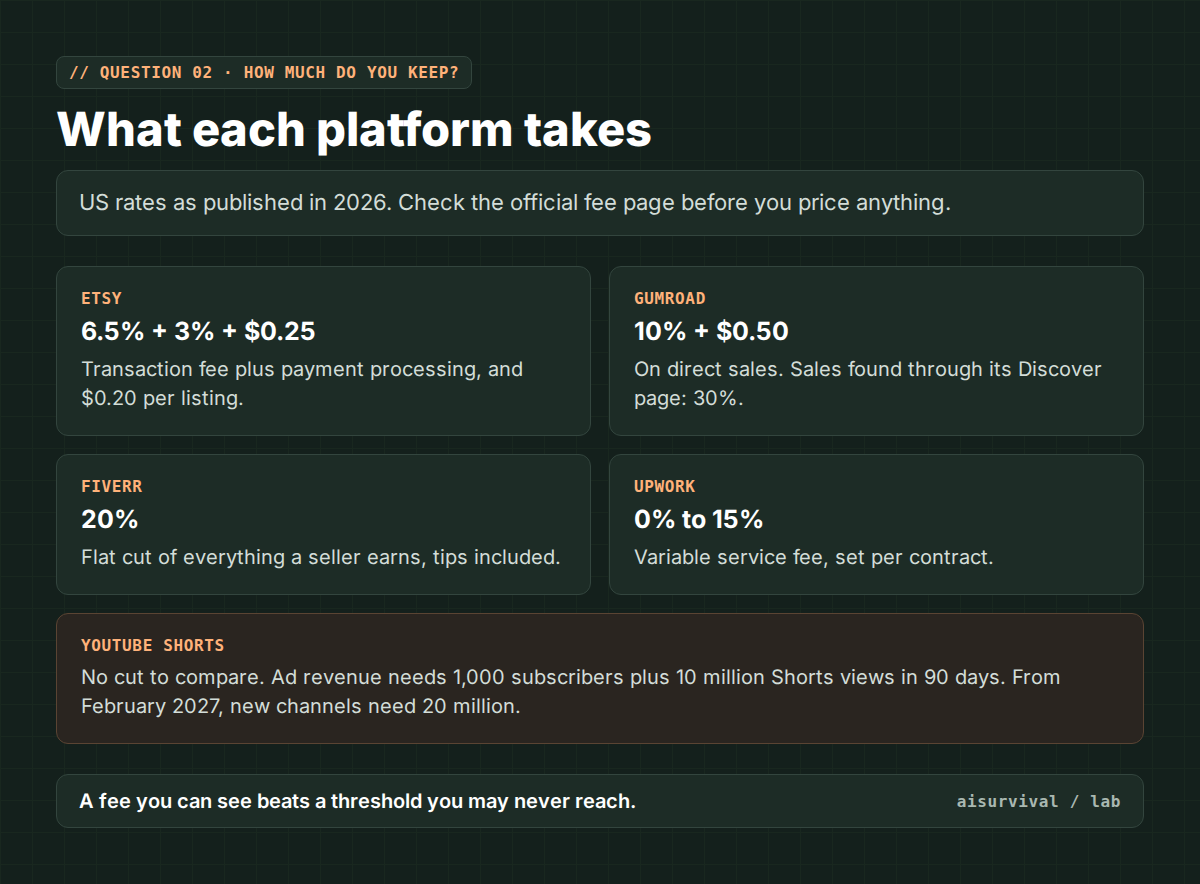
These are the numbers behind the “Keep” column. On Etsy, a US sale carries a $0.20 listing fee, a 6.5% transaction fee, and 3% + $0.25 payment processing (Checkout Page, verified against Etsy’s fee page). Gumroad takes 10% + $0.50 on direct sales and a flat 30% on sales that come through its Discover marketplace (Checkout Page). Fiverr keeps a flat 20% of seller earnings, and Upwork charges freelancers a variable 0% to 15% service fee (Upwork).
Fees change, sometimes without much warning. Treat this as a snapshot and check each platform’s official fee page before you set a price.
One more rule worth knowing if you sell on Etsy: AI-made items are allowed under “Designed by a seller” when they come from your own prompts, but you have to disclose AI use in the listing description, and AI prompt bundles don’t qualify (Etsy Creativity Standards).
The copy test
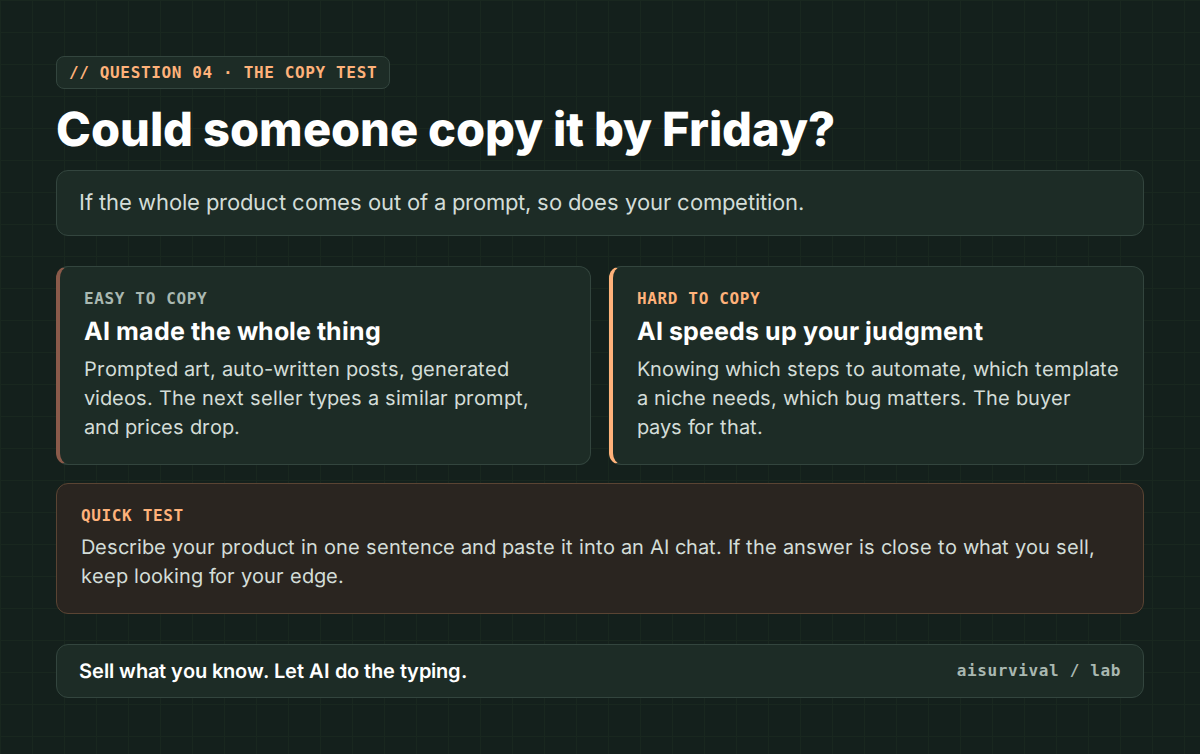
If you only use one question from this post, use this one. Describe what you’d sell in one sentence, paste it into an AI chat, and look at what comes back. If it’s close to your product, so is everyone else’s.
That doesn’t mean “avoid AI.” It means put AI behind something only you bring: experience in an industry, a niche you understand, a process you’ve done a hundred times at your day job. The hustles at the top of the sheet all work this way.
Copy-and-paste prompt: score your own idea
Your scores will differ from ours, because your skills and time are different. This prompt runs the same five questions on your idea. To use it:
- Write your idea in one sentence, plus the platform you’d sell on.
- List your edge: the skills, experience, or niche knowledge you’d bring.
- Copy the prompt in the gray box into ChatGPT, Claude, Gemini, or whichever AI chat you use. Turn on web search if it has one.
- Check every line marked [CHECK] on the platform’s official page.
- Answer its three questions, then ask it to rescore.
Tip: run it on two or three ideas in the same chat. Comparing totals side by side is more useful than any single score.
Prompt: Score my AI side hustle idea (fill in the brackets)
I am thinking about this side hustle:
Idea: [one sentence, e.g., Notion templates for freelance photographers]
Where I would sell: [e.g., Etsy, Gumroad, my own site, Upwork]
My edge: [skills, experience, or niche knowledge I bring]
Time I have: [hours per week]

Score it from 1 (bad for me) to 5 (good for me) on each question:
1. Proven demand: what evidence could I count today (sold listings, reviews, job posts)? Tell me where to look.
2. What I keep: platform and payment fees. Mark every fee [CHECK] so I verify it on the official page.
3. Time to first dollar: realistic weeks, given my hours.
4. Hard to copy: could someone with the same AI tools make the same thing in a week? What part depends on my edge?
5. Platform risk: 5 means no single company can switch off my income. Name any AI rules that apply.

For each score, give one sentence of reasoning. Then give the total out of 25.

Rules:
- Do not invent income numbers or success stories.
- If you are not sure about a fee or rule, say so.
- End with 3 questions whose answers would most change the total.
What’s next in this series
A score tells you where to look. It doesn’t tell you which tools to use once you start. The rest of this series compares AI tools one job at a time, with real prices, free limits, and platform rules checked on the day each post goes up:
- Week 1, content and planning basics: infographics, Pinterest pins, product descriptions, customer surveys, review analysis, interview note-takers, and one-page PRDs.
- Week 2, tools for small sellers: Etsy and KDP research, mockups, coloring pages, product photos, tags, and customer replies.
- Week 3, building a side project: no-code apps, landing pages, logos, short videos, social scheduling, affiliate sites, and slide decks.
- Week 4, product planning at work: competitor analysis, journey maps, roadmaps, A/B tests, market research, meeting notes, pitch decks, and pricing research.
The planning methods behind this series come from the product planning process series. If you want the long-range version of “is this worth building?”, the PEST analysis guide is a good next read.
Limits
- The 1-to-5 scores are judgments, not measurements. Two careful people could score the same hustle differently.
- Nothing here is an income estimate. Earnings depend on your skills, niche, time, and luck.
- Fees and platform rules were checked in October 2026 and can change at any time.
- The five questions skip things that matter to some people, like startup cost, taxes, or whether you’ll enjoy the work. Add them if they matter to you.
- This isn’t financial or legal advice. Check your employment contract before starting a side business, too.
FAQ
What is the best AI side hustle?
There isn’t one best for everyone. On this scoring sheet, services that use AI to speed up your own expertise, like automation setups for small businesses, score highest. Run the prompt above to score ideas against your own skills.
Can you sell AI-generated products on Etsy?
Yes, if they come from your own prompts and you disclose AI use in the listing description. AI prompt bundles aren’t allowed under Etsy’s Creativity Standards.
Do you have to disclose AI on Amazon KDP?
Yes, for AI-generated text, images, or translations. Amazon doesn’t require disclosure for AI-assisted work, where you created the content and used AI to edit or brainstorm.
Can a faceless AI YouTube channel make money?
It can, but the bar is high. Shorts ad revenue needs 10 million views in 90 days, rising to 20 million for new applicants from February 2027, and mass-produced AI videos can be rejected as inauthentic content.
Next in this series: 7 ways to make infographics with AI without a designer. Subscribe if you’d like it in your inbox.
Your turn: Which side hustle would you score differently, and why? Or tell us the idea you’re weighing. We’ll pick a few for a reader scoring post.