
QUICK ANSWER
Before anyone buys, they quietly ask four things: Can I trust this? Is it worth the price? Is saying yes easy? Will I want to come back? The 24 triggers below, drawn from behavioral science, each help answer one of those questions. Use only the ones your product can honestly back up. AI makes it cheap to fake reviews, urgency, and expertise, which is exactly why buyers now look harder for the real thing.
New sellers tend to describe what their product does. Buyers decide based on how it makes them feel and what it gets them. These triggers are the bridge between the two.
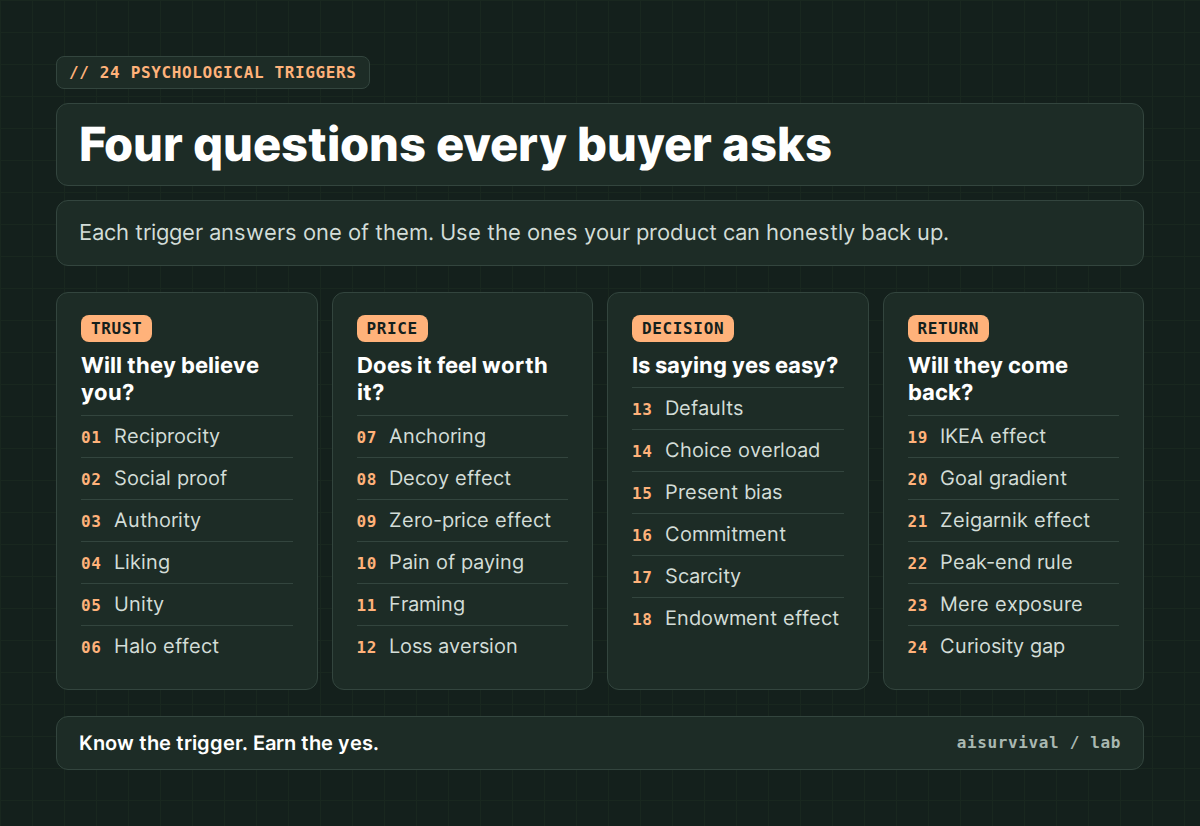
Several of these come from psychologist Robert Cialdini’s principles of persuasion: reciprocity, commitment and consistency, social proof, liking, authority, scarcity, and unity, which he added in the 2021 expanded edition of Influence (interview with Cialdini). The rest are well-known effects from behavioral economics.
Trust: will they believe you?
1. Reciprocity. People want to return a favor. So give away one genuinely useful AI prompt or template before you ask for anything.
2. Social proof. We follow what people like us are doing. Show real reviews and real usage counts, and never post reviews AI wrote.
3. Authority. We trust people who clearly know the subject. A before-and-after or a worked example proves that better than any title you could claim.
4. Liking. We buy from people we like and feel close to. Write the way you’d talk to a customer, not like a brochure.
5. Unity. We say yes more easily to someone who’s one of “us.” Pick one group, like Etsy sellers or solo founders, and speak their language.
6. Halo effect. One strong first impression colors everything after it. That’s why your first screen or first free sample needs to be your best work.
Price: does it feel worth it?
7. Anchoring. The first number people see shapes how they judge the next one. Show what the task costs in time or money without your product, then show your price.
8. Decoy effect. A third option can make one of the other two look like the obvious pick. Three tiers with a clearly better middle one works, as long as the middle one really is the better deal.
9. Zero-price effect. “Free” pulls far harder than “cheap.” A free starter version lowers the first step, but it has to be useful on its own.
10. Pain of paying. Every separate payment stings a little. One bundled price usually feels better than five small charges.
11. Framing. The same fact lands differently depending on how you put it. “Saves about an hour a week” beats a feature list, but only say it if you’ve measured it.
12. Loss aversion. Losing something hurts more than gaining the same thing feels good. Name what the problem really costs if it stays unsolved. Don’t invent a fear that isn’t there.
Decision: is saying yes easy?
13. Defaults. Most people keep whatever’s already selected. Pre-select the option most buyers actually need, and never pre-check add-ons they didn’t ask for.
14. Choice overload. Too many options can stall a decision. Launch with one to three offers, not a full catalog.
15. Present bias. We value results now over results later. Make sure buyers get one quick win in their first few minutes.
16. Commitment and consistency. After a small yes, a bigger yes feels natural. That’s why a free sample or a short quiz often comes before the full product.
17. Scarcity. Limited things feel more valuable. It only works honestly when the limit is real, like “20 custom spots, because each one is reviewed by hand.”
18. Endowment effect. Once something feels like ours, we value it more. A free trial that already has the buyer’s own data in it starts to feel like theirs.
Return: will they come back?
19. IKEA effect. We value things more when we helped make them. Let buyers adjust the AI output instead of handing them a finished block.
20. Goal gradient. People speed up as they get close to a goal. A simple “step 3 of 5” in onboarding or a course keeps them moving.
21. Zeigarnik effect. Unfinished tasks stick in our minds. End each lesson or email by naming the next small step.
22. Peak-end rule. People remember the best moment and the ending most. Make delivery the highlight, and close with a thank-you that includes one useful tip.
23. Mere exposure. Familiar things feel safer. Showing up every week in one place, like a newsletter, does more than appearing everywhere once.
24. Curiosity gap. We want to close the gap between what we know and what we want to know. Tease what the next piece answers, then actually answer it. Clickbait burns trust fast.
Where the line is
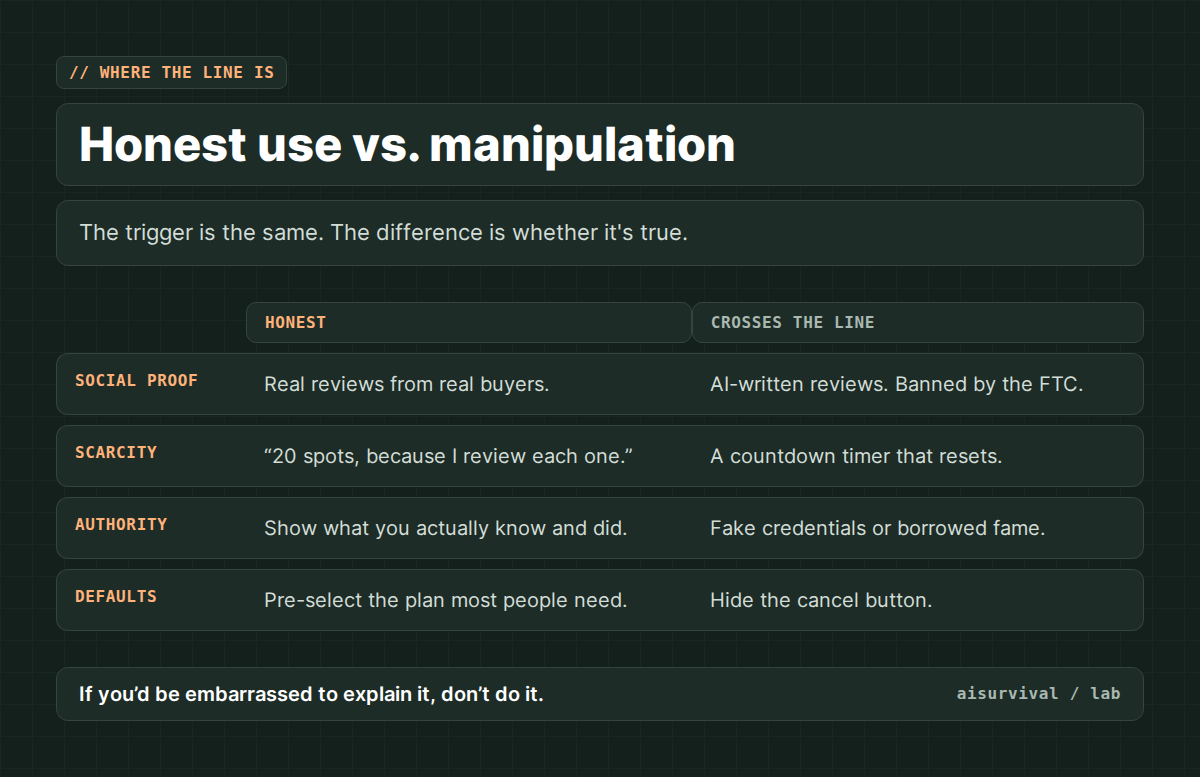
Every trigger above has a dishonest version, and AI makes the dishonest version easy to produce at scale. Some of it is now illegal in the US. The FTC’s rule on consumer reviews, in effect since October 21, 2024, bans fake reviews and testimonials, explicitly including AI-generated ones, and also bans buying fake followers or views (Alston & Bird).
A simple test: if you’d be embarrassed to explain to a customer how a trigger works on your page, take it off. This isn’t legal advice. Check the rules where you sell.
Copy-and-paste prompt: check your sales page against the 24 triggers
You’ve read the 24 triggers. Now see which ones your own sales page, listing, or launch post already uses, which of the four buyer questions it leaves unanswered, and whether any trigger crosses the line.
What you get back: a short report in three parts, using the trigger numbers from this post. Which triggers your page already uses (with the exact line quoted), which of the four groups is empty, and which triggers you should fix or remove before launch.
- Copy all the text from your sales page or listing.
- Paste it at the bottom of the prompt and run it in any AI chat.
- Fix the “Line crossed” items first. Then fill at most two empty groups.
Prompt: 24-trigger check for your sales page
Check my sales page against these 24 triggers, grouped by
the four questions a buyer asks.

TRUST (Can I believe this?)
1 Reciprocity, 2 Social proof, 3 Authority, 4 Liking,
5 Unity, 6 Halo effect
PRICE (Is it worth it?)
7 Anchoring, 8 Decoy effect, 9 Zero-price effect,
10 Pain of paying, 11 Framing, 12 Loss aversion
DECISION (Is saying yes easy?)
13 Defaults, 14 Choice overload, 15 Present bias,
16 Commitment and consistency, 17 Scarcity, 18 Endowment effect
RETURN (Will I come back?)
19 IKEA effect, 20 Goal gradient, 21 Zeigarnik effect,
22 Peak-end rule, 23 Mere exposure, 24 Curiosity gap

Give me a short report in three parts:

1. USED: Which triggers does my page already use?
   For each, give the number, the name, and the exact line.

2. EMPTY GROUPS: Which of the four groups has no trigger at all?
   For each empty group, suggest one honest sentence I could add.
   If it needs a fact I have not given you, write NEEDS PROOF.

3. LINE CROSSED: Which triggers are used in a way that could
   mislead a buyer? Give the number, the line, and why.

Do not invent reviews, numbers, or credentials.

My sales page:
[paste]
Example result (fictional page for a printable meal planner):
- Used: #9 Zero-price effect, “Includes a free sample week.” #14 Choice overload, only one plan is offered, so the choice is simple.
- Empty group: Trust. Nothing on the page shows the planner works. Try a before-and-after of a filled-in week (#3 Authority). NEEDS PROOF: use a real example, not a mock-up you never used.
- Line crossed: #17 Scarcity, “Only 3 left!” A digital file can’t run out, so this urgency isn’t real. Remove it.
FAQ
Are psychological triggers manipulative?
They don’t have to be. They describe how people already make decisions. They become manipulative when the thing they point to isn’t true, like fake scarcity or fake reviews.
Which triggers should a new AI business start with?
Trust first. Reciprocity, honest social proof, and showing real work matter most when nobody knows you yet.
Can I use AI to write my marketing copy?
Yes, as a first draft. Check every claim, and never let it write reviews or testimonials. That’s covered by the FTC rule.
Next step: before you write a sales page, check whether enough people want what you’re selling. Our guide to market sizing with AI shows how.
Your turn: Which trigger does your page lean on most right now? Tell us in the comments.